Ways to electrify bodies
Summary
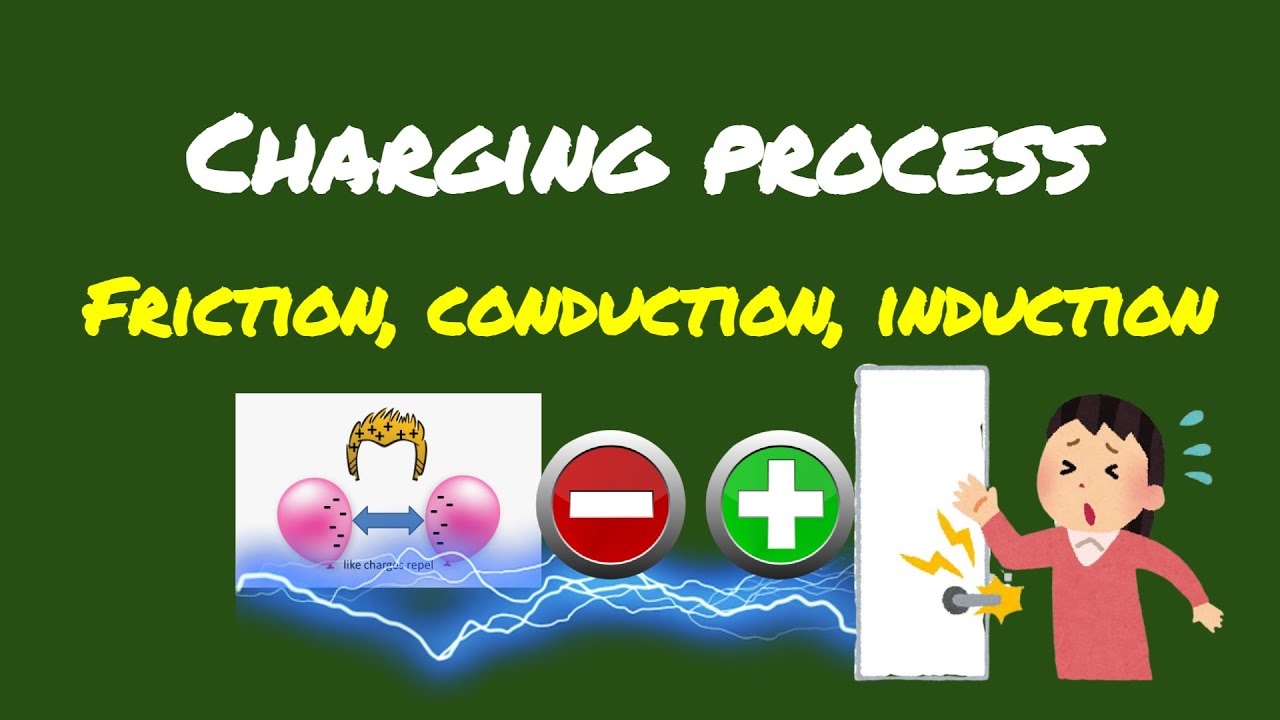
TLDRThis video explains the different ways objects can become electrically charged. It covers three main methods: friction, where rubbing objects transfers electrons and creates opposite charges; contact, where a charged object touches a neutral one and shares its charge; and induction, where a charged object causes a temporary redistribution of charges in a nearby neutral object without direct contact. Clear examples, like rubbing a balloon on hair or bringing charged plastic close to a neutral object, illustrate each process. The video highlights how electrons move and interact, making it easier to understand the behavior of electric charges in everyday materials.
Takeaways
- ⚡ Electric charges are present in all matter, but they are usually balanced and not easily noticeable.
- 🔬 Electrification processes allow atoms to gain or lose electrons, making electric charges observable.
- 🔄 Charging by friction occurs when two objects are rubbed together, causing electrons to transfer between them.
- 🎈 When a balloon is rubbed against hair, electrons move from the hair to the balloon, making the balloon negatively charged.
- 💇 Hair loses electrons during friction and becomes positively charged as a result.
- 🤝 Charging by contact happens when a charged object touches a neutral object and transfers some of its charge.
- ⚖️ After contact, both objects end up with similar types of charge, though not necessarily equal amounts.
- 🧲 Objects with the same type of charge repel each other after being charged by contact.
- 🌌 Charging by induction occurs without direct contact, due to the influence of an electric field from a charged object.
- 🔀 In induction, charges inside a neutral object rearrange, with opposite charges attracted and like charges repelled.
- 🧩 This rearrangement of charges within an object is called polarization.
- ⏳ Polarization is temporary and disappears once the charged object is removed.
- 🧠 All electrification processes involve the movement or redistribution of electrons between or within objects.
Q & A
What is the fundamental concept behind electrifying a body?
-Electrifying a body involves transferring or redistributing electric charges, specifically electrons, within the atoms of a material.
How does friction cause a body to become electrically charged?
-Friction generates a transfer of electrons between two materials that are rubbed together. One material loses electrons and becomes positively charged, while the other gains electrons and becomes negatively charged.
Can you give an example of charging by friction?
-Rubbing a balloon against hair transfers electrons from the hair to the balloon, resulting in a negatively charged balloon and positively charged hair.
What happens when a charged object comes into contact with a neutral object?
-In contact charging, the charged object transfers part of its charge to the neutral object until both have a similar distribution of charge, although not necessarily the same amount.
How does charging by contact differ from charging by friction?
-Charging by friction involves rubbing two neutral objects to transfer electrons, while charging by contact involves a charged object touching a neutral one to share its existing charge.
What is charging by induction and how does it occur?
-Charging by induction is a method where a neutral object becomes electrically polarized due to the electric field of a nearby charged object, without direct contact. This causes a temporary separation of charges within the neutral object.
What is polarization in the context of charging by induction?
-Polarization refers to the redistribution of charges within a neutral object when influenced by a nearby charged object, resulting in one side becoming temporarily positive and the other negative.
Does the neutral object remain electrically neutral when charged by induction?
-Yes, the neutral object remains electrically neutral overall, but its internal charges are temporarily separated due to polarization.
What is the effect on two objects that both become negatively charged?
-Two objects with the same type of charge, such as both being negatively charged, will repel each other due to the repulsion between like charges.
Why is it important to understand different methods of electrification?
-Understanding different methods of electrification helps explain everyday phenomena, such as static electricity, and is fundamental for studying electric fields, forces, and the behavior of charged materials.
How can the concept of electron transfer explain the behavior of everyday objects?
-Electron transfer explains why objects like balloons stick to walls or why combing hair can cause strands to repel each other. These effects result from the redistribution of electrons and the resulting electrical forces.
Outlines

Этот раздел доступен только подписчикам платных тарифов. Пожалуйста, перейдите на платный тариф для доступа.
Перейти на платный тарифMindmap

Этот раздел доступен только подписчикам платных тарифов. Пожалуйста, перейдите на платный тариф для доступа.
Перейти на платный тарифKeywords

Этот раздел доступен только подписчикам платных тарифов. Пожалуйста, перейдите на платный тариф для доступа.
Перейти на платный тарифHighlights

Этот раздел доступен только подписчикам платных тарифов. Пожалуйста, перейдите на платный тариф для доступа.
Перейти на платный тарифTranscripts

Этот раздел доступен только подписчикам платных тарифов. Пожалуйста, перейдите на платный тариф для доступа.
Перейти на платный тарифПосмотреть больше похожих видео

TIPOS DE ELETRIZAÇÃO: POR ATRITO, CONTATO E INDUÇÃO (ELETROSTÁTICA) | Resumo de Física para o Enem

Pengertian Arus Listrik - Fisika Kelas X

LISTRIK STATIS PART 2 | HUKUM COLOUMB

Eletrostática (Processos de Eletrização) - Aula 02

LISTRIK STATIS # belajar di rumah
CHARGING PROCESS | STATIC ELECTRICITY | FRICTION CONDUCTION INDUCTION
5.0 / 5 (0 votes)

