Kimia SMA - Koloid (1) - Pengenalan Sistem Koloid Kimia, Kimia Koloid (S)
Summary
TLDRThis educational video provides an in-depth introduction to colloids, explaining their definition, characteristics, and differences from solutions and suspensions. The presenter discusses dispersed systems, particle sizes, phase distribution, and how colloids behave compared to homogeneous and heterogeneous mixtures. Through easy-to-understand examples such as sugar water, milk, fog, foam, and jelly, viewers learn how to classify colloids based on their dispersed phase and dispersing medium. The lesson also covers common colloid types like aerosols, emulsions, sols, and foams, while solving practice questions to reinforce understanding. Overall, the video makes complex chemistry concepts more accessible and engaging for students.
Takeaways
- 😀 A dispersed system consists of two parts: the dispersed phase (solute) and the dispersing medium (solvent).
- 😀 Dispersed systems can be classified into three types: solutions, colloids, and suspensions, based on particle size and uniformity.
- 😀 Solution particles are smaller than 10^-7 cm, colloid particles range from 10^-7 to 10^-5 cm, and suspension particles are larger than 10^-5 cm.
- 😀 Solutions are homogeneous and transparent, while colloids and suspensions are heterogeneous and often appear cloudy.
- 😀 Solutions cannot be separated by filtration or membranes, colloids may pass through filters but not membranes, and suspensions settle quickly and can be easily separated.
- 😀 Colloids can take various forms such as sols, emulsions, foams, and aerosols, depending on the dispersed phase and medium.
- 😀 The name of a colloid depends on the phase of the dispersed substance and the medium, e.g., solid in liquid is a sol, liquid in liquid is an emulsion, gas in liquid is a foam, and liquid in gas is an aerosol.
- 😀 Particle sizes can also be expressed in nanometers: 1 nanometer equals 10^-7 cm, so colloid particles range from 10 to 1000 nm.
- 😀 Emulsifiers, like soap, help mix immiscible substances, e.g., oil and water, by stabilizing the colloidal system.
- 😀 Aerosols are colloids where a liquid or solid is dispersed in a gas, like mist or smoke, whereas foams are gas dispersed in a liquid or solid.
- 😀 Understanding the types and properties of colloids is essential for distinguishing between solutions, colloids, and suspensions in practical applications.
Q & A
What is a dispersed system according to the video?
-A dispersed system is a mixture of two substances (same or different states) in which one substance (the dispersed phase) is distributed evenly throughout another substance (the dispersing medium).
What are the three types of dispersed systems mentioned?
-The three types of dispersed systems are: solutions, colloids, and suspensions.
How are solutions, colloids, and suspensions distinguished by particle size?
-Solutions have particle diameters less than 10^-7 cm, colloids have particles between 10^-7 and 10^-5 cm, and suspensions have particles larger than 10^-5 cm.
Why are solutions considered homogeneous while colloids and suspensions are heterogeneous?
-Solutions are homogeneous because the particles are evenly distributed and form a single phase. Colloids and suspensions are heterogeneous because their particles do not mix uniformly and exist in two separate phases.
What is the difference in how solutions, colloids, and suspensions pass through filters and membranes?
-Solutions can pass through both filters and membranes, colloids can pass through filters but not membranes, and suspensions cannot pass through either filters or membranes.
What are some examples of colloids mentioned in the video?
-Examples of colloids include milk (liquid dispersed in liquid), agar-agar (solid dispersed in liquid), foam (gas dispersed in liquid), and aerosol (liquid or solid dispersed in gas).
How are colloids named based on their dispersed phase and dispersing medium?
-Colloids are named by combining the dispersed phase and the dispersing medium. For example, a solid dispersed in a liquid is called a sol, a liquid dispersed in a liquid is called an emulsion, and a gas dispersed in a liquid is called foam or froth.
What is the approximate particle size of colloids in nanometers?
-Colloid particles range from approximately 1 nanometer (10^-7 cm) to 100 nanometers (10^-5 cm).
What is the role of an emulsifying agent in a colloid?
-An emulsifying agent helps stabilize the colloid by allowing the dispersed phase and the dispersing medium to mix, preventing them from separating. For example, adding soap to a mixture of oil and water creates a stable emulsion.
Which colloidal system is an example of an aerosol, and why?
-Mist or fog is an example of an aerosol because it consists of liquid droplets dispersed in a gas medium (air), forming a two-phase system.
Why does a suspension settle faster than a colloid?
-Suspension particles are larger than colloid particles, so they are heavier and settle more quickly under the influence of gravity.
Can all colloids be seen with the naked eye or a normal microscope?
-No, colloid particles are too small to be seen with the naked eye and usually require an ultramicroscope to observe, whereas suspensions can often be seen with a regular microscope.
Outlines

このセクションは有料ユーザー限定です。 アクセスするには、アップグレードをお願いします。
今すぐアップグレードMindmap

このセクションは有料ユーザー限定です。 アクセスするには、アップグレードをお願いします。
今すぐアップグレードKeywords

このセクションは有料ユーザー限定です。 アクセスするには、アップグレードをお願いします。
今すぐアップグレードHighlights

このセクションは有料ユーザー限定です。 アクセスするには、アップグレードをお願いします。
今すぐアップグレードTranscripts

このセクションは有料ユーザー限定です。 アクセスするには、アップグレードをお願いします。
今すぐアップグレード関連動画をさらに表示
Sistem Koloid (1) | Jenis-jenis Koloid | Kimia kelas 11
Solution, Colloid or Suspension? The definition in Chemistry and examples (ft. mini quiz)
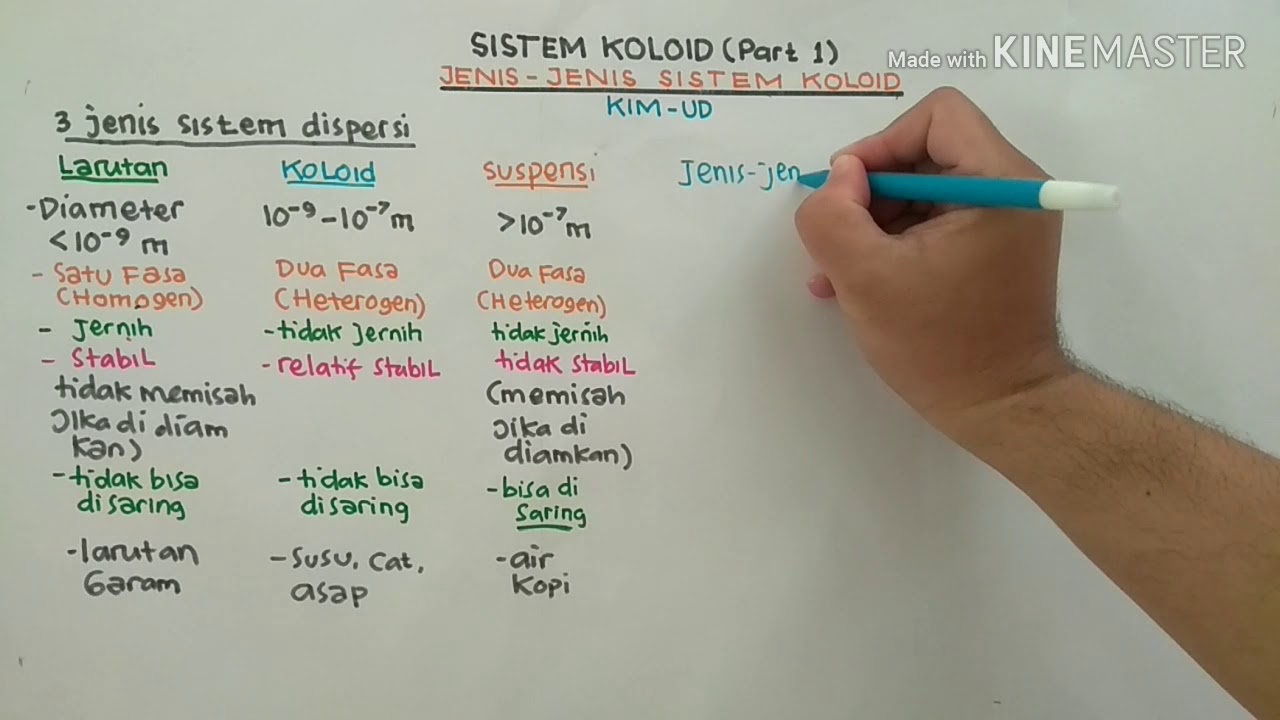
SISTEM KOLOID (Part 1), Jenis Sistem Koloid

Dispersões: Soluções, Suspensões e Coloides |O MELHOR RESUMO|

Estudo das Soluções - 01 Classificação das Dispersões

Colloids
5.0 / 5 (0 votes)

