Penerapan Pancasila dari Masa ke Masa
Summary
TLDRThe transcript explores the evolution and application of Pancasila, Indonesia's foundational state philosophy, from independence to the present. It highlights how students in grades 7 and 8 have studied Pancasila’s formulation, values, and significance as both the nation's foundation and a guiding life philosophy. Despite its broad acceptance, the text notes historical challenges, including attempts to replace or distort Pancasila, which were overcome by the nation. The discussion emphasizes ongoing threats in modern society and the international arena, stressing the importance of understanding Pancasila’s principles. The video ultimately traces its implementation across different periods: early independence, the Old Order, the New Order, and the Reform era.
Takeaways
- 😀 Students in grades 7 and 8 have previously learned about Pancasila, including its formulation, ratification, and its role as the foundation of the Indonesian state.
- 😀 Pancasila is recognized as both the state ideology and the philosophical basis for the nation's way of life.
- 😀 Understanding Pancasila is built on prior knowledge from earlier grades, making it easier for students to engage with this material.
- 😀 The implementation of Pancasila has faced ups and downs throughout Indonesia's history.
- 😀 There have been historical attempts to replace Pancasila with other ideologies, but these attempts were successfully thwarted by the Indonesian people.
- 😀 Despite past successes in protecting Pancasila, contemporary and future challenges can still pose threats to its values.
- 😀 The lesson aims to strengthen students’ understanding of Pancasila as both the foundation of the state and the nation's guiding principles.
- -
- 😀 The development of Pancasila’s implementation is traced from Indonesia’s early independence to the present day, covering the early independence period, the Old Order, the New Order, and the Reform era.
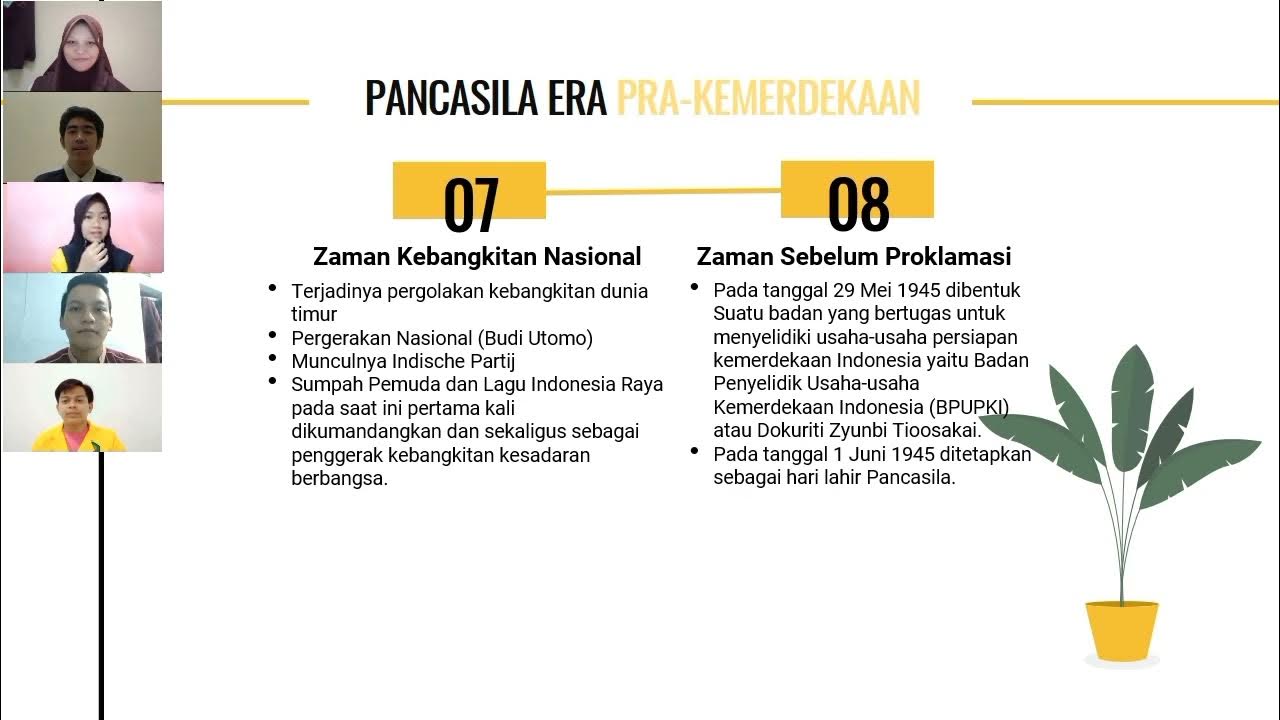
- 😀 During the early independence period (1945–1959), the Indonesian people were committed to defending their newfound independence and upholding Pancasila against internal and external threats.
- 😀 Early attempts to uphold Pancasila faced challenges, including efforts to replace it or deviations from its values.
- 😀 Recognizing the contributions of Indonesia's founding figures is important, as they successfully formulated and established Pancasila as the nation’s foundational philosophy.
Q & A
What prior knowledge from grades 7 and 8 helps students understand the current material on Pancasila?
-Students already learned about the formulation and ratification of Pancasila as the state foundation in grade 7, and the values of Pancasila as the state foundation and national worldview in grade 8. This background equips them to better understand its application over time.
Why is Pancasila important for Indonesia as a nation?
-Pancasila serves as both the foundation of the Indonesian state and the guiding philosophy of the nation, providing principles for governance, social life, and the nation’s identity.
Has Pancasila always been applied smoothly since Indonesia's independence?
-No, the implementation of Pancasila has experienced ups and downs. There were attempts to replace it with other ideologies, and deviations from its values occurred at various points in history.
How were threats to Pancasila as the state foundation addressed historically?
-Threats were countered by the Indonesian people themselves, demonstrating a national commitment to preserve Pancasila against ideological challenges.
Does the end of past threats mean Pancasila faces no challenges today?
-No, contemporary and future challenges—arising from societal changes in Indonesia and globally—can still pose risks to the values of Pancasila, requiring ongoing awareness and reinforcement.
What is the focus of the chapter discussed in the transcript?
-The chapter focuses on the historical development and application of Pancasila as the state foundation and national philosophy from Indonesia's independence to the present, including its implementation during the early independence period, the Old Order, the New Order, and the Reform era.
What role did the founders of Indonesia play in Pancasila’s establishment?
-The founders successfully formulated and ratified Pancasila as the state foundation and the nation’s philosophical guide, securing a framework for Indonesia’s independence and governance.
How did Indonesia implement Pancasila in the early independence period (1945–1959)?
-During this period, the people were committed to shaping the nation’s destiny after colonial rule, defending independence from internal and external threats, while also encountering attempts to replace or distort Pancasila.
What were some challenges to Pancasila in its early application?
-Challenges included efforts to replace Pancasila with other ideologies and deviations from its core values, which tested the nation’s commitment to the principles of Pancasila.
Why is it important for students to understand the historical application of Pancasila?
-Understanding its historical application helps students recognize the efforts to protect Indonesia’s ideological foundation, learn from past challenges, and appreciate the ongoing relevance of Pancasila in guiding national life.
Outlines

このセクションは有料ユーザー限定です。 アクセスするには、アップグレードをお願いします。
今すぐアップグレードMindmap

このセクションは有料ユーザー限定です。 アクセスするには、アップグレードをお願いします。
今すぐアップグレードKeywords

このセクションは有料ユーザー限定です。 アクセスするには、アップグレードをお願いします。
今すぐアップグレードHighlights

このセクションは有料ユーザー限定です。 アクセスするには、アップグレードをお願いします。
今すぐアップグレードTranscripts

このセクションは有料ユーザー限定です。 アクセスするには、アップグレードをお願いします。
今すぐアップグレード



5.0 / 5 (0 votes)

