FORCES & MOTION - GCSE Physics
Summary
TLDRThis video covers the fundamental concepts of forces, motion, and energy. It explains the difference between contact and non-contact forces, vector representation of forces, and Newton's laws of motion. The script discusses topics like friction, air resistance, tension, and gravitational potential energy. It also delves into Hooke's Law, work done, moments, pressure, and the conservation of momentum. Real-world examples, such as the impact of speed on braking distance and the use of safety features in cars, illustrate the principles of physics. The content also highlights the relationship between force, mass, and acceleration in practical scenarios.
Takeaways
- 😀 Forces can be contact forces (like pushing a door) or non-contact forces (like gravity or magnetism).
- 😀 Vectors represent forces, where direction and magnitude are crucial. The magnitude is indicated by the length of the arrow.
- 😀 Balanced forces result in no acceleration or constant velocity, as per Newton's First Law of Motion.
- 😀 Scalars have magnitude only (e.g., distance, speed), while vectors also include direction (e.g., displacement, velocity).
- 😀 Weight is the force due to gravity and is calculated by multiplying mass by gravitational field strength (9.8 N/kg on Earth).
- 😀 To lift or lower an object at a constant speed, the upward force must equal the weight of the object.
- 😀 Work done (energy transferred by a force) equals force multiplied by distance moved. This is the same as the equation for gravitational potential energy.
- 😀 Hooke's Law relates force, spring constant, and extension for elastic materials. Force and extension are directly proportional.
- 😀 The energy stored in a spring is given by the equation: E = 1/2 k e² (where k is the spring constant and e is the extension).
- 😀 Newton's Laws of Motion describe the relationship between forces, motion, and acceleration. The second law (F = ma) is a key equation for predicting acceleration.
- 😀 In collisions, momentum is conserved, but kinetic energy is rarely conserved. The principle of conservation of momentum applies to the total momentum before and after the collision.
Q & A
What are the two main types of forces mentioned in the script?
-The two main types of forces are contact forces, where objects are physically touching (e.g., pushing a door), and non-contact forces, such as magnetism, electrostatic forces, and gravity.
What is the difference between vectors and scalars?
-Vectors have both magnitude and direction (e.g., displacement, velocity), while scalars only have magnitude without direction (e.g., speed, mass).
What does Newton's first law of motion state?
-Newton's first law of motion states that an object will remain at a constant velocity (including staying stationary) unless acted upon by a resultant force. This means the forces on the object are balanced.
How do you calculate the weight of an object?
-Weight is calculated by multiplying the mass (in kilograms) by the gravitational field strength (g). On Earth, g is approximately 9.8 N/kg, but you may round it to 10 N/kg depending on the context.
What is Hooke's Law and how is it related to springs?
-Hooke's Law states that the force applied to a spring is proportional to the extension or compression, which is represented by the formula F = k * e, where F is the force, k is the spring constant, and e is the extension. This only applies if the object stretches or compresses elastically.
How is the energy stored in a spring calculated?
-The energy stored in a spring is calculated using the formula E = 1/2 k * e^2, where k is the spring constant and e is the extension or compression of the spring.
What is the principle of moments?
-The principle of moments states that for an object to be in equilibrium and not rotate, the sum of the clockwise moments must equal the sum of the anticlockwise moments.
What is the equation for pressure, and how is it related to force?
-Pressure is defined as force divided by area (P = F / A). The unit of pressure is Pascals (Pa), where 1 Pa equals 1 Newton per square meter.
What factors affect gas pressure?
-Gas pressure is affected by the number of gas particles (more particles lead to higher pressure), the temperature (higher temperature increases pressure), and the volume of the container (reducing volume increases pressure).
What is momentum, and how is it calculated?
-Momentum is a measure of an object's motion and is calculated using the formula p = m * v, where p is momentum, m is mass, and v is velocity. Momentum is a vector quantity, meaning it has both magnitude and direction.
Outlines

このセクションは有料ユーザー限定です。 アクセスするには、アップグレードをお願いします。
今すぐアップグレードMindmap

このセクションは有料ユーザー限定です。 アクセスするには、アップグレードをお願いします。
今すぐアップグレードKeywords

このセクションは有料ユーザー限定です。 アクセスするには、アップグレードをお願いします。
今すぐアップグレードHighlights

このセクションは有料ユーザー限定です。 アクセスするには、アップグレードをお願いします。
今すぐアップグレードTranscripts

このセクションは有料ユーザー限定です。 アクセスするには、アップグレードをお願いします。
今すぐアップグレード関連動画をさらに表示
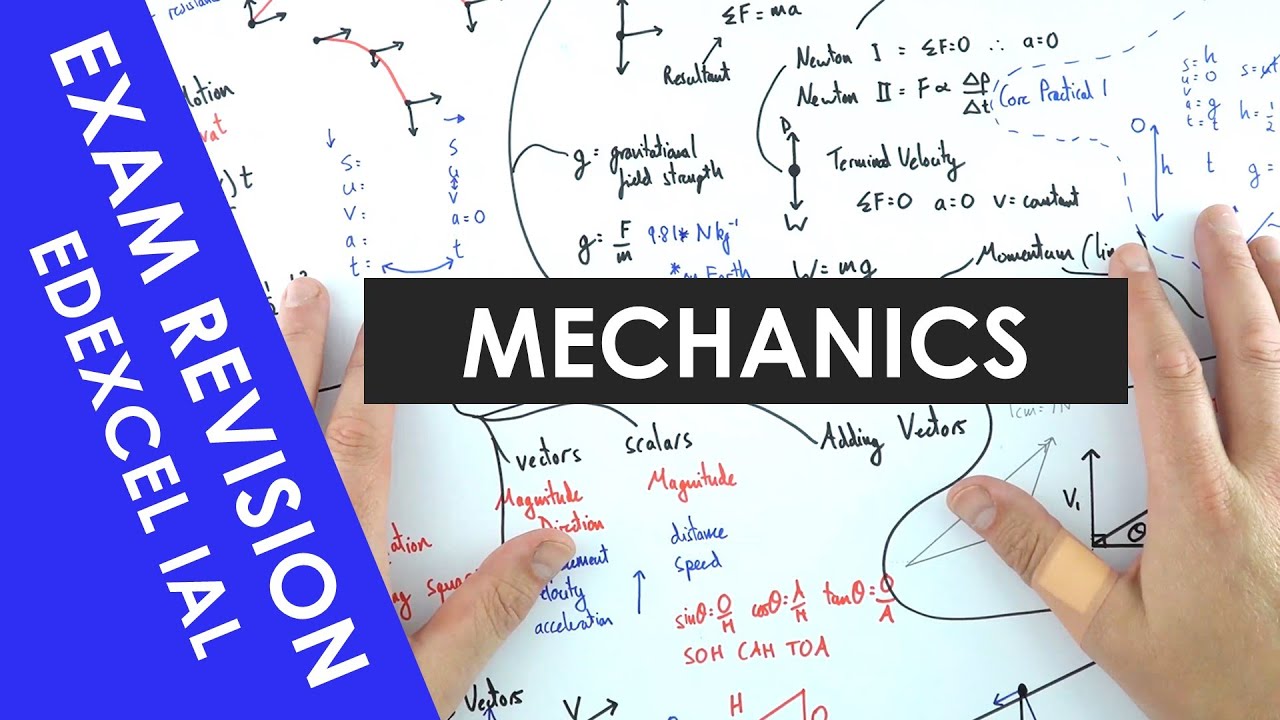
Edexcel IAL Mechanics - A Level Physics Revision

Video pembelajaran Gerak, Gaya, Hukum Newton, Usaha dan Energi

Graphing Energy (VPython for Physics 1)

FISIKA KINEMATIKA KELAS XI JARAK PERPINDAHAN KELAJUAN KECEPATAN PART 1 KURIKULUM MERDEKA

Fisika Kelas 10 - Dinamika Partikel Hukum Newton dan Contoh Soal

Gerak Partikel Bermuatan dalam Medan Listrik Seragam
5.0 / 5 (0 votes)

