Origem da Vida na Terra - Aula | ANIMAÇÃO
Summary
TLDRThe video, presented by Professor Lucas, explores the origin of life on Earth. It explains how the early Earth, formed about 4.6 billion years ago, was initially a hot, hostile environment constantly bombarded by asteroids. Over time, cooling allowed rain to form oceans, and energy from lightning and solar radiation facilitated the creation of simple organic molecules like amino acids. The video covers key hypotheses, including Oparin and Haldane's theory of chemical evolution, the experiments supporting biogenesis by Pasteur and Miller-Urey, and alternative ideas like panspermia. It also touches on the evolutionary process that led from simple unicellular life to the diversity of organisms we see today.
Takeaways
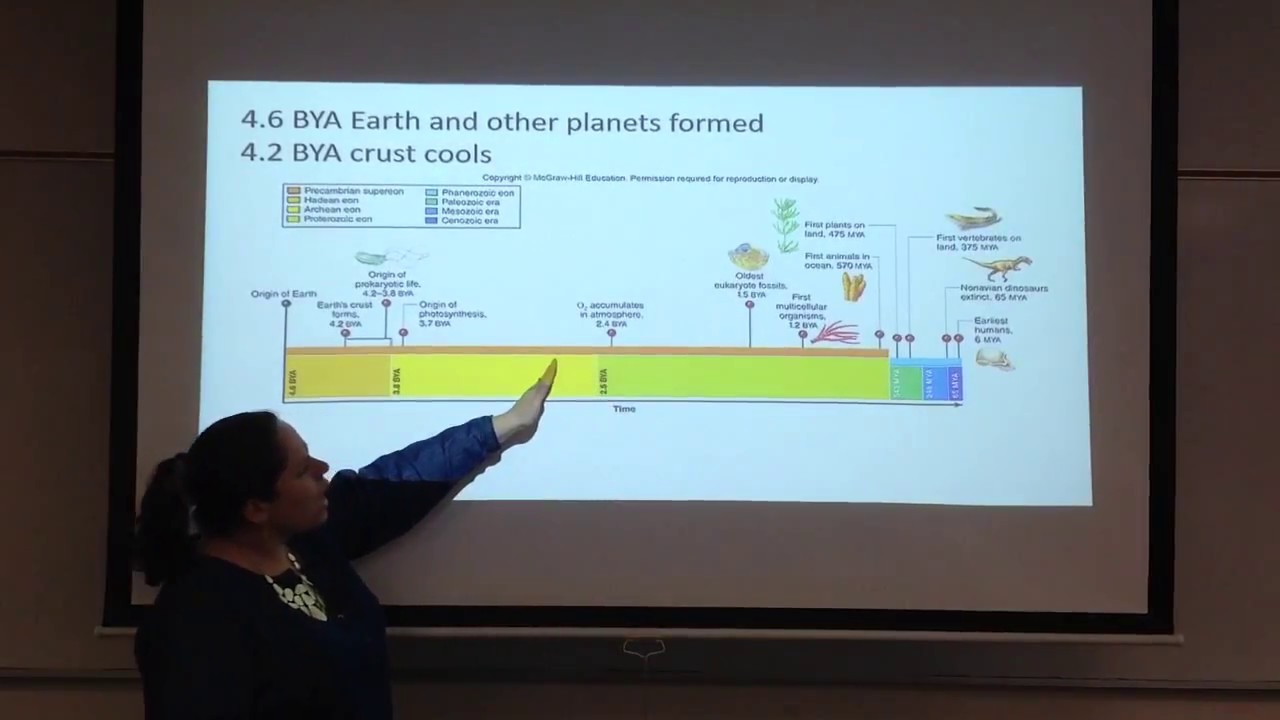
- 😀 The Earth is around 4.6 billion years old and formed from the agglomeration of particles in a vast stellar dust cloud.
- 🌍 The Earth's surface was initially extremely hot, with large parts made of molten rock.
- 🌑 Asteroids constantly impacted the Earth, but the chances of life forming under such harsh conditions were low.
- 💧 Water from meteorites and volcanic activity, along with lightning, likely contributed to forming the first organic molecules, such as amino acids.
- ⚡ Lightning, solar radiation, and volcanic activity likely played a role in forming the first molecules of life on Earth.
- 🌊 As the Earth cooled, rainwater accumulated in low areas, forming the first oceans.
- 🧬 The first living organisms may have originated from coacervates—simple structures formed by organic molecules in solution.
- 🦠 These first life forms were probably unicellular and similar to prokaryotes, the ancestors of all living beings.
- 🔬 Evolution involves changes in organisms over time through processes like mutation, genetic drift, and natural selection.
- 💡 The idea of abiogenesis (life originating from non-living matter) was challenged by experiments, leading to the acceptance of biogenesis (life originating from pre-existing life).
- 🔬 The Miller-Urey experiment in 1953 simulated the conditions of early Earth and supported the hypothesis that amino acids could form in such an environment.
- 🌌 The panspermia hypothesis suggests that life may not have originated on Earth but was transported from space via meteorites, although this theory doesn’t explain the origin of life.
Q & A
What is the estimated age of the Earth?
-The Earth is approximately 4.6 billion years old, formed from the agglomeration of particles from a massive stellar dust cloud.
What was the surface of the Earth like during its early formation?
-During the Earth's early formation, the temperature was extremely high, and the surface was largely composed of molten rock.
How did meteorites contribute to the formation of Earth's atmosphere?
-Meteorites likely brought large amounts of water to Earth, and the heat from these impacts caused evaporation, which eventually formed dense clouds that led to intense rainstorms.
What role did lightning and solar radiation play in the early atmosphere?
-The energy from lightning and solar radiation likely facilitated chemical reactions that led to the formation of simple organic molecules like amino acids.
What are coacervates and how are they related to the origin of life?
-Coacervates are structures formed from large organic molecules that, over time, may have developed into the first living organisms due to the development of genetic material and the ability to reproduce.
What is the concept of abiogenesis?
-Abiogenesis is the idea that life can arise from non-living matter, such as how Aristotle believed life could emerge from decaying matter like meat, which was later disproven through scientific experiments.
How did the experiments of Francesco Redi challenge the theory of abiogenesis?
-Francesco Redi's experiment showed that maggots only appeared in open jars with decaying meat, not in sealed jars, disproving the idea that life could spontaneously generate from decaying matter.
What was Louis Pasteur's contribution to proving biogenesis?
-Louis Pasteur conducted an experiment with a swan-neck flask that showed life only emerged from existing life when the flask was tilted, confirming the theory of biogenesis.
What did the Miller-Urey experiment demonstrate about the origins of life?
-The Miller-Urey experiment simulated early Earth conditions and demonstrated that amino acids, the building blocks of life, could form from simple gases, supporting the hypothesis that life could arise from chemical processes.
What is the panspermia hypothesis regarding the origin of life?
-The panspermia hypothesis suggests that life may not have originated on Earth but could have been transported here from space, possibly via meteorites, though it doesn't explain how life began in the first place.
Outlines

Cette section est réservée aux utilisateurs payants. Améliorez votre compte pour accéder à cette section.
Améliorer maintenantMindmap

Cette section est réservée aux utilisateurs payants. Améliorez votre compte pour accéder à cette section.
Améliorer maintenantKeywords

Cette section est réservée aux utilisateurs payants. Améliorez votre compte pour accéder à cette section.
Améliorer maintenantHighlights

Cette section est réservée aux utilisateurs payants. Améliorez votre compte pour accéder à cette section.
Améliorer maintenantTranscripts

Cette section est réservée aux utilisateurs payants. Améliorez votre compte pour accéder à cette section.
Améliorer maintenant




5.0 / 5 (0 votes)

