Life Cycle of HIV
Summary
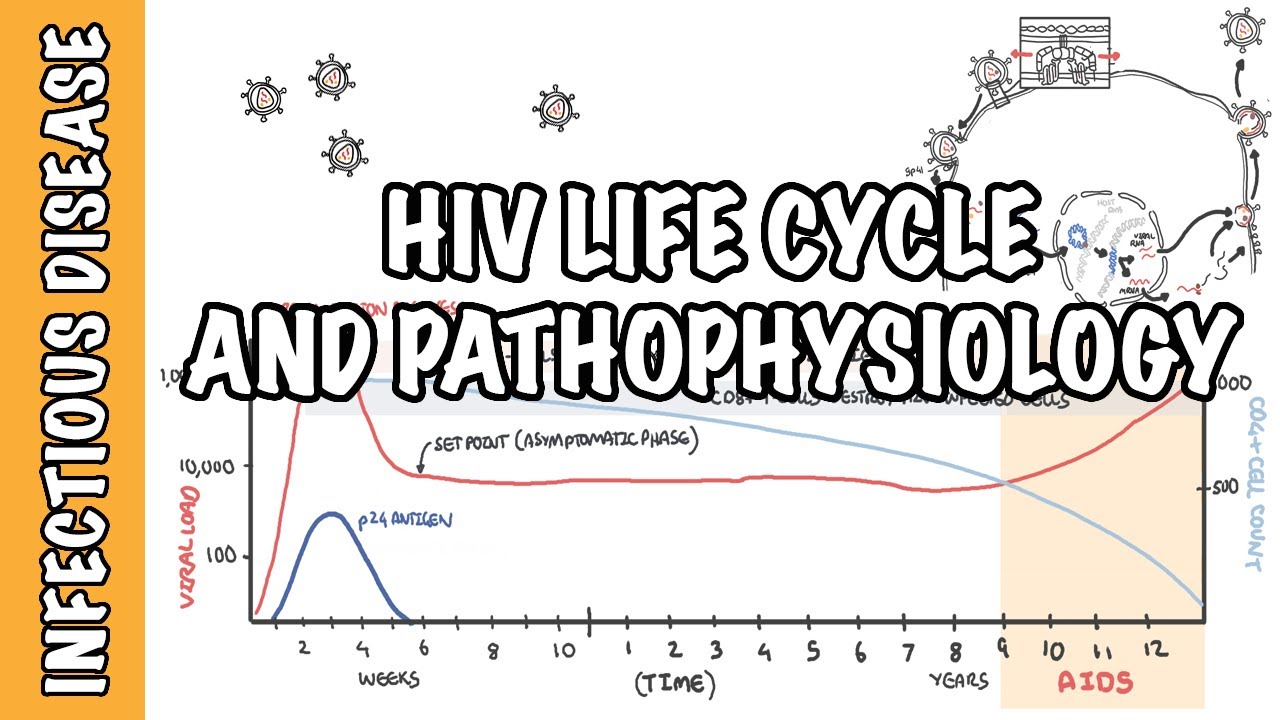
TLDRThis video explains the complete life cycle of HIV, from initial entry into the bloodstream to the production of mature viral particles ready to infect new T cells. It details how the virus attaches to T cells using CD4 and co-receptors, fuses with the cell membrane, and transports its RNA genome toward the nucleus. Reverse transcriptase converts viral RNA into DNA, which is integrated into the host genome by integrase. The viral DNA is transcribed, spliced, exported, and translated into proteins, while new viral RNA and proteins assemble at the cell membrane. Finally, budding and protease-mediated maturation produce infectious virions, continuing the cycle of infection.
Takeaways
- 🦠 HIV is a tiny virus, about 100 nanometers in diameter, roughly 100 times smaller than its target T cells.
- 🔗 HIV attaches to T cells by binding to CD4 proteins and a co-receptor, triggering membrane fusion.
- ⚡ The viral envelope protein undergoes a conformational change to insert into the T cell membrane and allow capsid entry.
- 🚚 Once inside, HIV moves toward the nucleus along microtubules, using the cell's transport system.
- 🔄 Reverse transcriptase converts the viral RNA genome into double-stranded DNA while degrading the original RNA.
- 🧬 Integrase inserts the viral DNA into the host genome, creating a provirus that can remain dormant or become active.
- 📝 Viral DNA is transcribed into RNA by RNA polymerase, bypassing transcriptional pauses via the P-TEFb complex.
- 🧩 Viral RNA is processed, exported from the nucleus with the help of Rev protein, and either translated into proteins or packaged for new virions.
- 🏗️ Viral proteins, including Gag and envelope proteins, assemble at the cell membrane, encapsulating the viral RNA as the virus buds.
- ✂️ Protease cleaves Gag proteins during maturation, forming functional capsid and nucleocapsid proteins, resulting in infectious mature viruses.
- 🔄 The HIV life cycle is continuous, with mature viruses ready to infect new host cells, repeating the cycle.
Q & A
How does HIV first enter the body?
-HIV first enters the body through the bloodstream. The virus is surrounded by a membrane containing viral proteins known as envelope proteins.
What role do the envelope proteins of HIV play in infection?
-The envelope proteins on HIV interact with membrane proteins on the surface of target cells, such as T cells, allowing the virus to attach and begin the process of fusion with the cell.
What happens when HIV binds to the CD4 proteins on a T cell?
-The initial binding of HIV occurs through CD4 proteins on the T cell, and this binding triggers the need for a second membrane protein, called a co-receptor, to facilitate a conformational change in the viral envelope protein.
How does the fusion process work during HIV infection?
-After binding, the envelope protein changes shape, allowing it to insert into the T cell membrane. This leads to the fusion of the viral membrane with the T cell membrane, allowing the viral capsid to enter the T cell.
What is the role of reverse transcriptase in HIV infection?
-Reverse transcriptase (RT) is an enzyme that converts the viral RNA genome into a DNA copy. It works by using cellular nucleotides, degrading the RNA, and creating a complete double-stranded DNA copy of the viral genome.
What happens after the HIV genome enters the nucleus of the host cell?
-Once the viral genome reaches the nucleus, the integrase protein facilitates the insertion of the viral DNA into the host cell's genome. This can remain dormant or become activated later, leading to viral replication.
What is the process of transcription in HIV replication?
-Transcription is the first stage of HIV replication, where the viral DNA is copied into RNA by RNA polymerase. This RNA serves as a template for producing viral proteins and new viral genomes.
How does HIV bypass transcriptional pauses during RNA synthesis?
-HIV bypasses transcriptional pauses by recruiting a protein complex called pTEFb, which helps RNA polymerase continue RNA synthesis after initial transcription initiation.
How are viral proteins produced in the infected cell?
-Some viral RNA transcripts are translated into viral proteins by cellular ribosomes. These proteins include the viral gag protein, which is essential for the formation of new viral particles.
What happens during the final stages of HIV virion assembly?
-During the final stages, viral proteins like gag form a lattice structure that helps bud the virus from the cell membrane. Additional proteins, such as scission proteins, cause the membrane to divide, releasing the newly formed virus.
How does the HIV virus mature after being released from the host cell?
-After release, the virus undergoes maturation, where protease enzymes cut the gag protein into smaller pieces, which helps form the capsid around the viral RNA, making the virus ready for another round of infection.
Outlines

Dieser Bereich ist nur für Premium-Benutzer verfügbar. Bitte führen Sie ein Upgrade durch, um auf diesen Abschnitt zuzugreifen.
Upgrade durchführenMindmap

Dieser Bereich ist nur für Premium-Benutzer verfügbar. Bitte führen Sie ein Upgrade durch, um auf diesen Abschnitt zuzugreifen.
Upgrade durchführenKeywords

Dieser Bereich ist nur für Premium-Benutzer verfügbar. Bitte führen Sie ein Upgrade durch, um auf diesen Abschnitt zuzugreifen.
Upgrade durchführenHighlights

Dieser Bereich ist nur für Premium-Benutzer verfügbar. Bitte führen Sie ein Upgrade durch, um auf diesen Abschnitt zuzugreifen.
Upgrade durchführenTranscripts

Dieser Bereich ist nur für Premium-Benutzer verfügbar. Bitte führen Sie ein Upgrade durch, um auf diesen Abschnitt zuzugreifen.
Upgrade durchführenWeitere ähnliche Videos ansehen

HIV Life Cycle | HHMI BioInteractive Video

HIV life cycle: How HIV infects a cell and replicates itself using reverse transcriptase

Retroviruses
Como atua a medicação para o HIV? | Mecanismo de ação dos antirretrovirais | AIDS | Profilaxia
Human immunodeficiency virus (HIV) - life cycle, pathophysiology, investigations, diagnosis and AIDS

#03 REPRODUKSI VIRUS 1 (LITIK)
5.0 / 5 (0 votes)

