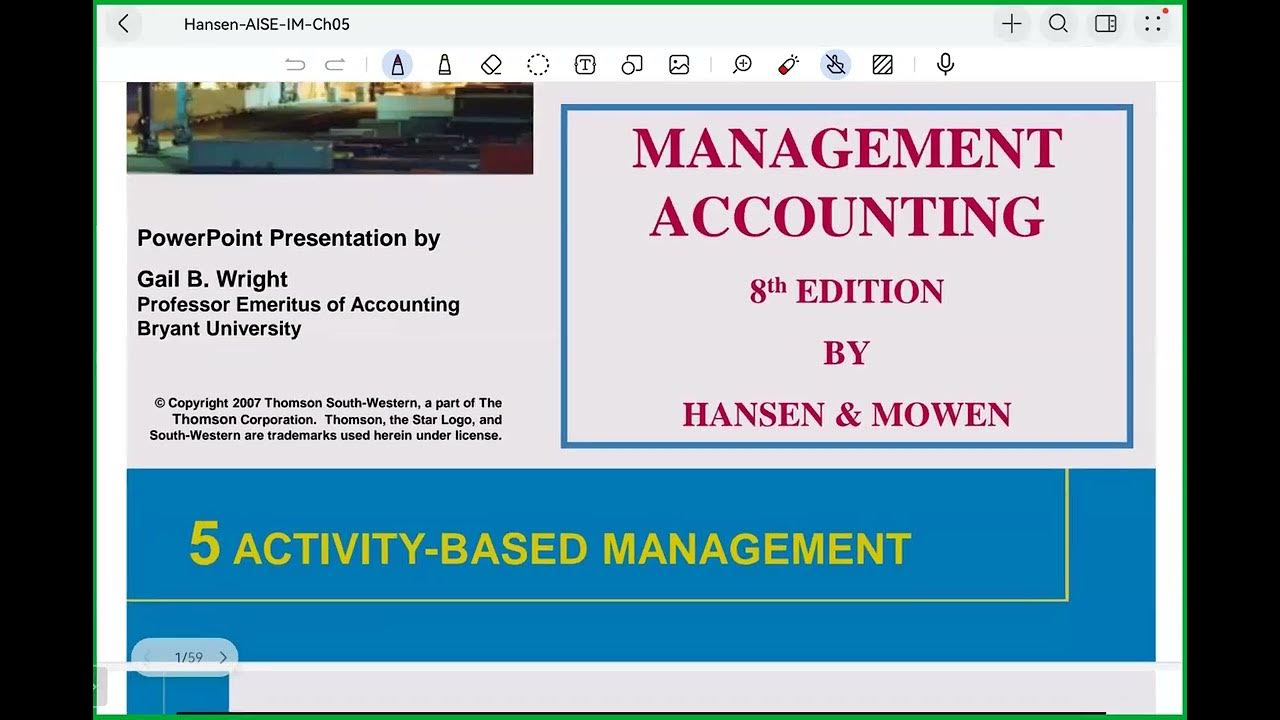
Akuntansi Manajemen (Bab 5): Activity-Based Management. Part 2
Summary
TLDRThis video script delves into Activity-Based Management (ABM), covering key concepts such as measuring activity performance, non-value-added activities, and implementing Activity-Based Costing (ABC) with a focus on customers and suppliers. It explores techniques like value-added analysis, trend reporting, Kaizen, and benchmarking to improve company efficiency. Additionally, it emphasizes managing activity capacity and cost analysis for suppliers. By using real-world examples, the script illustrates how companies can optimize processes, reduce costs, and improve overall profitability by focusing on value-adding actions and evaluating supplier performance.
Takeaways
- 📊 Activity-Based Management (ABM) evaluates performance by distinguishing between value-added and non-value-added activities to improve efficiency.
- ⚠️ Non-value-added activities represent inefficiencies and should be reduced or eliminated to lower operational costs.
- 📈 Comparing standard (ideal) performance with actual results helps identify gaps and areas for improvement.
- 🔍 Non-value-added cost reports provide insight into how much waste exists in company processes.
- 📉 Trend reporting tracks performance improvements over time, showing whether cost reduction efforts are successful.
- 🔄 Kaizen emphasizes continuous improvement by gradually reducing time and cost per activity.
- 🏆 Benchmarking allows companies to compare performance with best practices, often using internal comparisons due to data accessibility.
- ⚙️ Activity capacity management identifies unused capacity, highlighting inefficiencies in resource utilization.
- 👥 Activity-Based Costing (ABC) can be applied to customers to evaluate profitability, not just to products.
- 💸 Large customers tend to be more profitable due to fewer orders and lower service costs compared to small customers with frequent orders.
- 📦 Companies can improve profitability by encouraging customers to place fewer but larger orders.
- 🏭 ABC can also evaluate suppliers by considering total cost, including quality issues and delivery delays, not just purchase price.
- 🚚 Supplier performance issues such as defects and late deliveries can lead to additional costs like repairs and expediting.
- 💡 A supplier with a higher unit price may actually be more cost-effective if they provide better quality and reliability.
- 🎯 Overall, ABM and ABC help organizations make better strategic decisions by focusing on efficiency, cost drivers, and total value.
Q & A
What is the main focus of the third point discussed in the transcript?
-The third point focuses on how to measure the performance of activities within a company using several methods such as value-added analysis, trend reporting, Kaizen, benchmarking, and activity capacity management.
What is a value-added vs. non-value-added activity?
-A value-added activity contributes directly to improving the product or service from the customer’s perspective, while a non-value-added activity does not add value and should ideally be reduced or eliminated.
How is inefficiency identified using value-added cost reports?
-Inefficiency is identified by comparing actual costs (actual quantity × standard price) with value-added costs (standard quantity × standard price). The difference represents non-value-added costs.
Why is the ideal standard for some activities like rework or inspection considered zero?
-Because in an ideal scenario, products are produced perfectly without defects, eliminating the need for rework or inspection if quality is assured from the start.
What is the purpose of trend reporting in activity-based management?
-Trend reporting helps management track improvements over time by comparing non-value-added costs across different periods, showing whether efficiency initiatives are effective.
What is Kaizen and how is it applied in this context?
-Kaizen refers to continuous improvement. In the example, it is applied by reducing testing time per unit, which lowers the cost per test and improves efficiency.
What is benchmarking and what are its types?
-Benchmarking is the process of comparing performance against best practices. It can be external (comparing with other companies) or internal (comparing across branches within the same company).
Why is internal benchmarking more commonly used than external benchmarking?
-Because companies are usually unwilling to share proprietary information with competitors, making it easier to benchmark internally across different branches or units.
What is activity capacity management?
-It is a method used to assess how well a company utilizes its available capacity, identifying unused capacity and calculating variances such as activity volume variance.
What does activity volume variance indicate?
-It indicates the cost of unused capacity by comparing the standard quantity of activity with the actual quantity used.
How does Activity-Based Costing (ABC) apply to customers?
-ABC assigns costs based on customer behavior, such as number of orders and interactions, revealing that smaller customers with frequent orders may be less profitable despite similar sales volume.
Why can small customers be less profitable than large customers in ABC analysis?
-Because small customers often place more frequent orders and require more interactions, increasing order processing and service costs.
What strategic action can a company take based on customer ABC analysis?
-The company can encourage small customers to place larger, less frequent orders, possibly through discounts, to reduce operational costs.
How is ABC applied to supplier evaluation?
-ABC considers not only purchase price but also quality, defect rates, and delivery reliability, incorporating costs like rework and expedited shipping.
Why might a supplier with a higher unit price be more cost-effective overall?
-Because higher-quality suppliers may have fewer defects and delays, reducing additional costs such as repairs and expedited production, resulting in lower total cost.
Outlines

Dieser Bereich ist nur für Premium-Benutzer verfügbar. Bitte führen Sie ein Upgrade durch, um auf diesen Abschnitt zuzugreifen.
Upgrade durchführenMindmap

Dieser Bereich ist nur für Premium-Benutzer verfügbar. Bitte führen Sie ein Upgrade durch, um auf diesen Abschnitt zuzugreifen.
Upgrade durchführenKeywords

Dieser Bereich ist nur für Premium-Benutzer verfügbar. Bitte führen Sie ein Upgrade durch, um auf diesen Abschnitt zuzugreifen.
Upgrade durchführenHighlights

Dieser Bereich ist nur für Premium-Benutzer verfügbar. Bitte führen Sie ein Upgrade durch, um auf diesen Abschnitt zuzugreifen.
Upgrade durchführenTranscripts

Dieser Bereich ist nur für Premium-Benutzer verfügbar. Bitte führen Sie ein Upgrade durch, um auf diesen Abschnitt zuzugreifen.
Upgrade durchführen



5.0 / 5 (0 votes)

