DUPLA FENDA: O EXPERIMENTO QUE QUEBROU A LÓGICA DA REALIDADE!
Summary
TLDRThis transcript dives deep into the concept of wave-particle duality, exploring how particles like electrons can behave as both waves and particles. The discussion traces the historical development of quantum mechanics, from Einstein's photoelectric effect to De Broglie's hypothesis and the famous double-slit experiment. The conversation also touches on the uncertainty principle, emphasizing the intrinsic limitations of measuring both the position and velocity of particles. The participants add a humorous and informal tone, making complex quantum concepts more relatable, while explaining that at the quantum level, certainty is replaced by probabilities.
Takeaways
- 😀 Wave-particle duality: Light can behave both as a wave and as a particle, a concept first proposed by Einstein and later extended to electrons by De Broglie.
- 😀 The double-slit experiment shows that particles like electrons can exhibit interference patterns, behaving like waves, but only when not measured.
- 😀 If detectors are used in the double-slit experiment, the particles behave as particles, not waves, showing the role of measurement in quantum systems.
- 😀 The uncertainty principle, proposed by Heisenberg, states that you cannot measure both the position and momentum of a particle with perfect accuracy.
- 😀 Quantum mechanics operates on probabilities, meaning the exact position of a particle can't be determined until it is measured.
- 😀 The concept of wave function collapse suggests that when a quantum measurement is made, the particle's probabilistic wave function collapses into a definite state.
- 😀 The observer effect refers to the idea that the presence of a detector changes the behavior of quantum particles, although this doesn't involve human consciousness.
- 😀 Popular science misrepresents quantum principles, often leading to misleading interpretations like quantum consciousness or the observer determining reality.
- 😀 Quantum mechanics challenges classical physics by describing a world where particles exist in a superposition of states and only take definite positions when measured.
- 😀 The discussion humorously critiques the overuse of quantum mechanics in pop culture, especially in books and films that incorrectly apply quantum principles to spirituality and consciousness.
- 😀 The nature of quantum mechanics is intrinsic and cannot be reduced to measurement errors, highlighting the probabilistic and unpredictable nature of subatomic particles.
Q & A
What was the key idea behind Louis de Broglie's doctoral thesis?
-Louis de Broglie proposed that particles, such as electrons, could also exhibit wave-like behavior, similar to light. This challenged the classical view of particles as having only particle characteristics.
How did de Broglie’s hypothesis challenge traditional physics?
-De Broglie's hypothesis suggested that particles like electrons could behave as waves, just as light could behave as both a wave and a particle. This was a radical idea because electrons were traditionally considered pure particles with mass and charge.
What experimental evidence confirmed de Broglie's hypothesis?
-The confirmation came when the son of J.J. Thomson showed that a beam of electrons could diffract when passing through a slit, just like light waves. This demonstrated that electrons could indeed behave as waves.
What is the double-slit experiment, and why is it significant?
-The double-slit experiment involves shining light or particles through two slits and observing the pattern on a screen. If light is treated as a wave, it creates an interference pattern. The experiment is crucial because it showed that even particles like electrons could produce interference patterns, acting as waves under certain conditions.
How does the observer affect the outcome in quantum mechanics?
-In quantum mechanics, the act of measuring or observing can change the behavior of particles. The experiment discussed shows that if a detector is placed to observe the electrons passing through the slits, the interference pattern disappears, and the electrons behave like particles again.
What is the role of the 'observer' in quantum experiments?
-The concept of the 'observer' in quantum mechanics often leads to confusion. The 'observer' refers not to a human but to the detection apparatus that interacts with the quantum system. The measurement itself causes the system to 'collapse' from a probabilistic wave function to a definite state.
What does 'wave-particle duality' mean?
-Wave-particle duality is the principle that particles like light and electrons exhibit both wave-like and particle-like properties. Depending on the experimental setup, they may behave as particles or waves, as demonstrated by the double-slit experiment.
What is the Heisenberg Uncertainty Principle?
-The Heisenberg Uncertainty Principle states that it is impossible to precisely measure both the position and momentum (or velocity) of a particle at the same time. The more precisely one of these properties is measured, the less precisely the other can be known.
How does the uncertainty principle relate to the nature of quantum objects?
-The uncertainty principle reflects the intrinsic nature of quantum objects. In the quantum world, there is a limit to how accurately we can measure certain pairs of properties, such as position and velocity, because of the inherent uncertainty in these measurements.
What is the concept of a 'probabilistic wave function' in quantum mechanics?
-In quantum mechanics, the wave function represents a probability distribution of where a particle might be found in space. Before measurement, a particle's position is not definite but exists as a range of probabilities, and it 'collapses' into a specific state when observed.
Outlines

Dieser Bereich ist nur für Premium-Benutzer verfügbar. Bitte führen Sie ein Upgrade durch, um auf diesen Abschnitt zuzugreifen.
Upgrade durchführenMindmap

Dieser Bereich ist nur für Premium-Benutzer verfügbar. Bitte führen Sie ein Upgrade durch, um auf diesen Abschnitt zuzugreifen.
Upgrade durchführenKeywords

Dieser Bereich ist nur für Premium-Benutzer verfügbar. Bitte führen Sie ein Upgrade durch, um auf diesen Abschnitt zuzugreifen.
Upgrade durchführenHighlights

Dieser Bereich ist nur für Premium-Benutzer verfügbar. Bitte führen Sie ein Upgrade durch, um auf diesen Abschnitt zuzugreifen.
Upgrade durchführenTranscripts

Dieser Bereich ist nur für Premium-Benutzer verfügbar. Bitte führen Sie ein Upgrade durch, um auf diesen Abschnitt zuzugreifen.
Upgrade durchführenWeitere ähnliche Videos ansehen
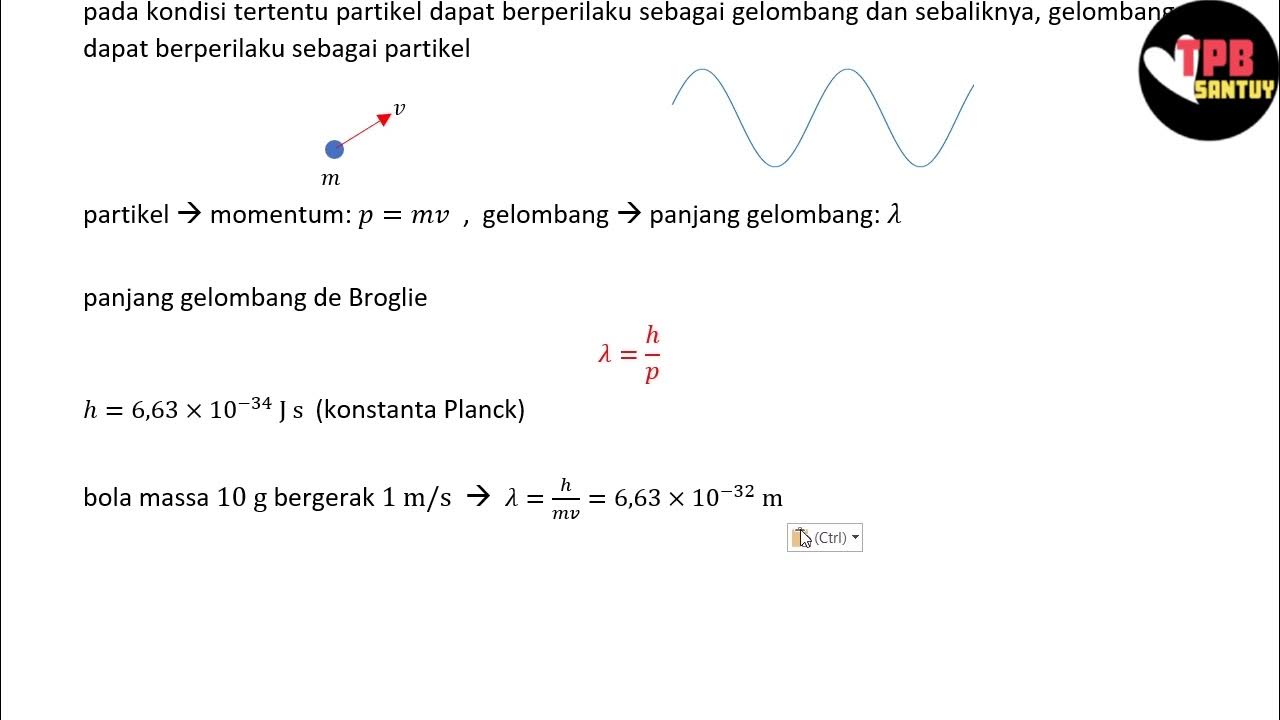
Dualisme Gelombang-Partikel | Fenomena Kuantum | Part 1 | Fisika Dasar

Quantum 101 Episode 1: Wave Particle Duality Explained

Física Quântica (Dr. Quantum) Fenda Dupla - Dublado PT

Davisson-Germer Experiment & Wave-Particle Duality
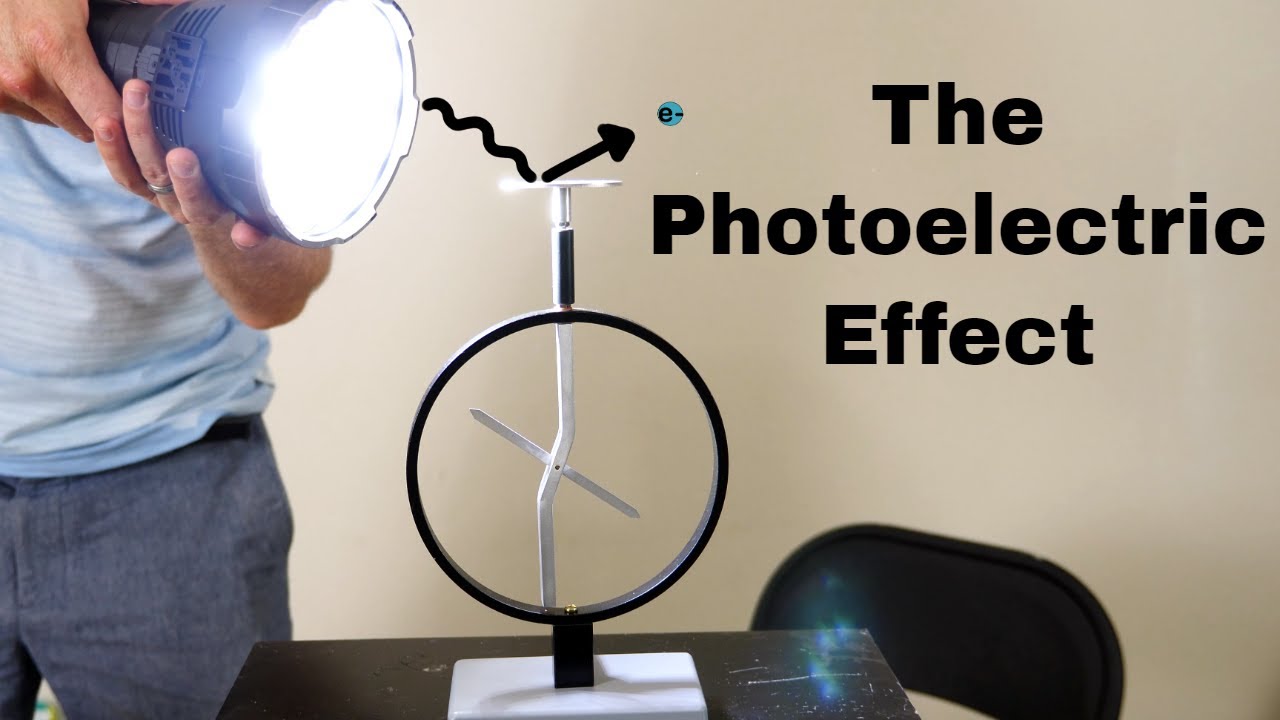
Knocking Electrons With Light—The Photoelectric Effect

The biggest lie about the double slit experiment
5.0 / 5 (0 votes)

