Fisika kelas X - Getaran Harmonik Sederhana part 1 - Teori Pegas & Getaran Harmonik Sederhana
Summary
TLDRThis video provides an in-depth explanation of simple harmonic motion (SHM), focusing on spring constants, series and parallel spring configurations, and their relationship to forces, extensions, and energy. The instructor discusses how to calculate force, mass, and extension using Hooke's law, and introduces the concepts of displacement, velocity, and acceleration in SHM. Additionally, energy calculations are explored, covering both kinetic and potential energy in oscillatory motion. The lesson concludes with a practical example of calculating values based on spring constants and extensions. The instructor encourages further learning through likes, subscriptions, and shares.
Takeaways
- 😀 Springs in series have the same force but different extensions, and their total spring constant is calculated using the reciprocal sum formula.
- 😀 Springs in parallel have the same extension but share the total force, with the total spring constant being the sum of individual constants.
- 😀 To solve complex spring systems, combine series and parallel springs step by step to find the total spring constant.
- 😀 Hooke's Law (F = k * Δx) is used to calculate the force on each spring based on its extension.
- 😀 The displacement (Δx or Δy) of a spring indicates how far it stretches or compresses from its equilibrium position.
- -
- 😀 In simple harmonic motion, displacement y(t) is given by y = A * sin(ωt + θ0), where A is amplitude, ω is angular velocity, and θ0 is the initial phase.
- 😀 The velocity of a vibrating object is v(t) = ω * A * cos(ωt + θ0) and the maximum velocity is v_max = ω * A.
- 😀 The acceleration of a vibrating object is a(t) = -ω² * A * sin(ωt + θ0) and the maximum acceleration is a_max = ω² * A.
- 😀 The angular velocity ω in a spring-mass system is related to the spring constant and mass by ω = √(K_total / m).
- 😀 The kinetic energy of a vibrating object is E_k = 1/2 * m * v², the potential energy is E_p = 1/2 * K * y², and the total mechanical energy is constant.
- 😀 The amplitude represents the maximum displacement from the equilibrium position and is used to calculate maximum velocity, acceleration, and energies.
Q & A
What is the difference between springs arranged in series and in parallel?
-In series, springs are connected end-to-end, and the total spring constant is calculated using the reciprocal sum formula: 1/K_total = 1/K1 + 1/K2 + …. In parallel, springs are connected side-by-side, and the total spring constant is the sum: K_total = K1 + K2 + …. In series, the force on each spring is the same, but the extension can differ. In parallel, the extension is the same, but the force is divided among the springs.
How do you calculate the total spring constant for two springs in series?
-For two springs in series with constants K1 and K2, the total spring constant K_total is calculated as: 1/K_total = 1/K1 + 1/K2. Then take the reciprocal of the sum to find K_total.
How do you calculate the total spring constant for springs in parallel?
-For springs in parallel, simply add their spring constants: K_total = K1 + K2 + K3 + ….
What is the relationship between the force and the extension of a spring?
-The force on a spring is proportional to its extension according to Hooke's Law: F = K * ΔX, where F is the force, K is the spring constant, and ΔX is the extension of the spring.
What is the meaning of displacement in simple harmonic motion?
-Displacement is the distance of the oscillating object from its equilibrium (rest) position at a given time. It is measured in meters (m) or centimeters (cm).
How do you express the displacement of an object in simple harmonic motion mathematically?
-Displacement can be expressed as y(t) = A * sin(ωt + θ0), where A is the amplitude, ω is the angular frequency, t is time, and θ0 is the initial phase angle.
What is the formula for velocity in simple harmonic motion?
-Velocity is given by v(t) = ω * A * cos(ωt + θ0). The maximum velocity occurs when cos(ωt + θ0) = 1, giving v_max = ωA.
How is acceleration related to displacement in simple harmonic motion?
-Acceleration is proportional to displacement but in the opposite direction: a(t) = -ω^2 * y(t). The maximum acceleration is a_max = ω^2 * A.
How can the angular frequency ω be calculated using mass and spring constant?
-The angular frequency ω for a mass-spring system is ω = sqrt(K/m), where K is the spring constant and m is the mass of the object.
What are the expressions for kinetic, potential, and total mechanical energy in simple harmonic motion?
-Kinetic energy: E_k = 1/2 * m * v^2 = 1/2 * m * (ωA * cos(ωt + θ0))^2. Potential energy: E_p = 1/2 * K * y^2. Total energy: E_total = E_k + E_p = 1/2 * K * A^2, which remains constant throughout the motion.
What is the significance of amplitude in simple harmonic motion?
-Amplitude (A) represents the maximum displacement from the equilibrium position. It determines the maximum values of velocity, acceleration, and potential energy in the motion.
How do you find the force on individual springs when a combination of series and parallel springs is used?
-First, combine the series springs using 1/K_total_series = 1/K1 + 1/K2. Then combine this result with parallel springs by summing constants. For springs in series, the force on each is the same. For parallel springs, the total force is divided among them proportionally based on their spring constants. Use F = K * ΔX to find individual forces.
Outlines

Dieser Bereich ist nur für Premium-Benutzer verfügbar. Bitte führen Sie ein Upgrade durch, um auf diesen Abschnitt zuzugreifen.
Upgrade durchführenMindmap

Dieser Bereich ist nur für Premium-Benutzer verfügbar. Bitte führen Sie ein Upgrade durch, um auf diesen Abschnitt zuzugreifen.
Upgrade durchführenKeywords

Dieser Bereich ist nur für Premium-Benutzer verfügbar. Bitte führen Sie ein Upgrade durch, um auf diesen Abschnitt zuzugreifen.
Upgrade durchführenHighlights

Dieser Bereich ist nur für Premium-Benutzer verfügbar. Bitte führen Sie ein Upgrade durch, um auf diesen Abschnitt zuzugreifen.
Upgrade durchführenTranscripts

Dieser Bereich ist nur für Premium-Benutzer verfügbar. Bitte führen Sie ein Upgrade durch, um auf diesen Abschnitt zuzugreifen.
Upgrade durchführenWeitere ähnliche Videos ansehen
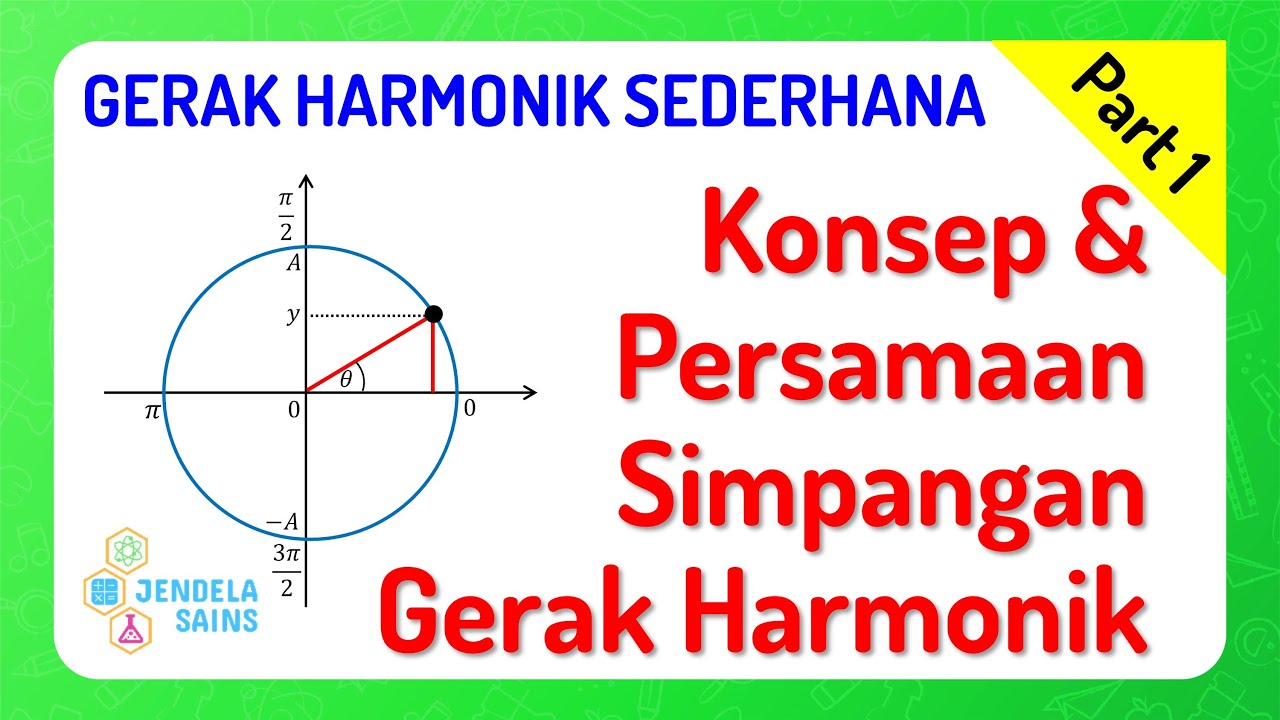
Gerak Harmonik Sederhana • Part 1: Konsep & Persamaan Simpangan Getaran Harmonis

Simple Harmonic Motion(SHM) - Force, Acceleration, & Velocity at 3 Positions

Demonstrating What Changes the Period of Simple Harmonic Motion(SHM)

GERAK HARMONIK SEDERHANA: MATERI FISIKA KELAS XI

Fisika SMA - Gerak Harmonik (1) - Pengenalan Gerak Harmonik Sederhana, Periode dan Frekuensi (I)
Aula 1 – Movimentos Periódicos e Introdução ao MHS
5.0 / 5 (0 votes)

