AGUA, ELECTROLITOS Y TRANSPORTE// FISIOLOGÍA// EL SEMESTROSO
Summary
TLDRThis video explains the importance of water and electrolytes in the body, detailing how water is distributed across different compartments such as intracellular and extracellular spaces. It highlights the influence of factors like age, gender, and body fat percentage on total body water. Additionally, the video covers the mechanisms of transport across membranes, including passive and active transport, as well as diffusion, facilitated diffusion, and co-transport. The video aims to provide a deeper understanding of cellular functions and the movement of substances in and out of cells, emphasizing the critical role of water in maintaining bodily functions.
Takeaways
- 😀 The body contains a significant amount of water, which can make up about 60% of a person's total body weight.
- 😀 A 70 kg person has around 42 liters of total body water, which can vary depending on age, gender, and body fat percentage.
- 😀 Newborns have a higher percentage of water in their bodies, with up to 70% total body water.
- 😀 Men typically have about 60% of their body weight as water, while women have about 50%, due to differences in body fat composition.
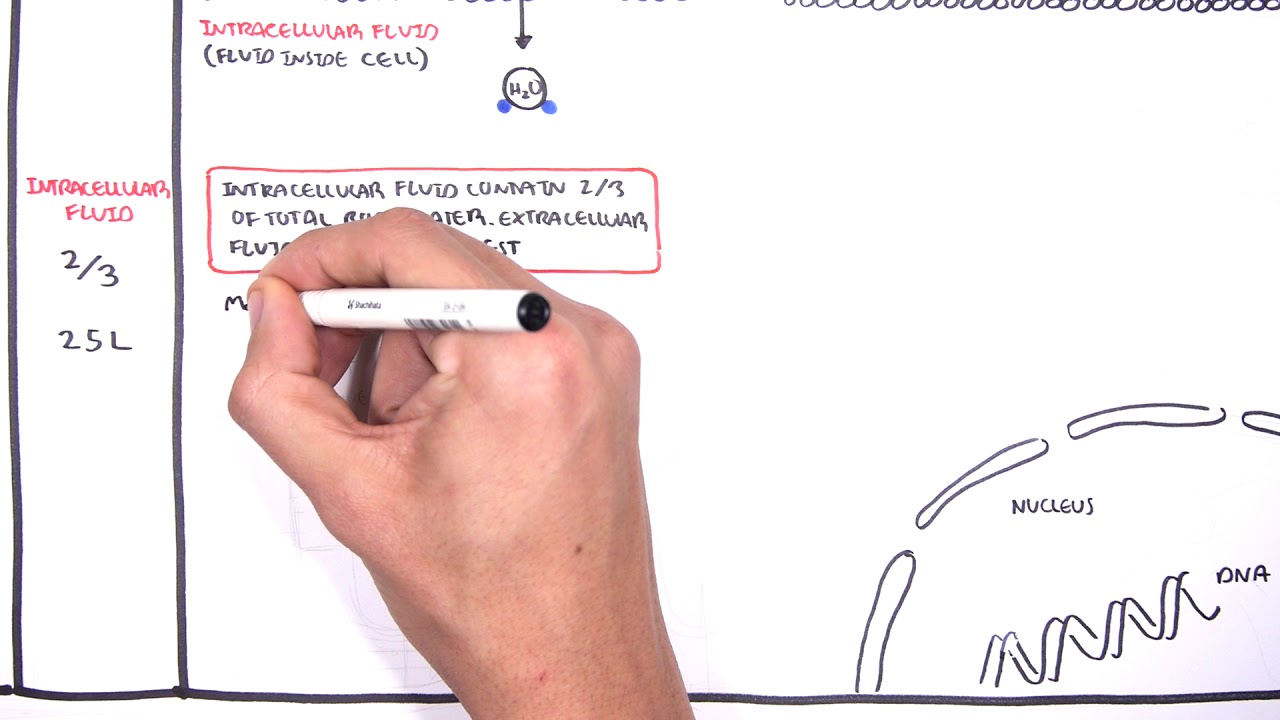
- 😀 The total body water is distributed into two main compartments: intracellular fluid (40%) and extracellular fluid (20%).
- 😀 Extracellular fluid is further divided into interstitial fluid (15%) and intravascular fluid (5%), the latter contributing to blood volume.
- 😀 Extracellular fluid contains high concentrations of sodium (135-145 mEq/L), while intracellular fluid contains high concentrations of potassium (120-150 mEq/L).
- 😀 Membrane transport refers to the movement of substances through the cell membrane, which can be either passive or active.
- 😀 Passive transport does not require energy and occurs down the electrochemical gradient. Examples include diffusion and facilitated diffusion.
- 😀 Active transport requires energy (ATP) and can occur against the electrochemical gradient. Primary and secondary active transport are two subtypes.
- 😀 Transport mechanisms can be classified by the number of molecules moved: uniport (one molecule), co-transport (two or more molecules in the same direction), and counter-transport (two or more molecules in opposite directions).
Q & A
What is the total body water (TBW) percentage in a 70 kg individual?
-In a 70 kg person, approximately 60% of their body weight is water, which translates to about 42 liters of total body water.
How does age affect the percentage of total body water?
-As a person gets older, their total body water percentage decreases. For example, neonates can have up to 70% of their body weight as water.
How does gender influence total body water distribution?
-Men typically have around 60% of their body weight as water, while women have about 50% due to differences in muscle and fat composition.
Why do women have a lower percentage of total body water compared to men?
-Women tend to have more body fat, which has a lower capacity to store water, leading to a lower percentage of total body water.
What are the two main compartments where body water is stored?
-Body water is primarily stored in two compartments: intracellular fluid (ICF), which holds 40% of total body water, and extracellular fluid (ECF), which holds 20%.
What are the sub-compartments of extracellular fluid?
-Extracellular fluid is divided into two sub-compartments: interstitial fluid (15% of total body water) and intravascular fluid (5% of total body water).
What is the role of sodium and potassium in body fluids?
-Sodium is primarily found in extracellular fluid (135-145 mEq/L), while potassium is predominantly found in intracellular fluid (120-150 mEq/L).
What are the two main types of membrane transport?
-There are two main types of transport: passive transport, which does not require energy and occurs down the electrochemical gradient, and active transport, which requires energy and can go against the gradient.
What is the difference between primary and secondary active transport?
-Primary active transport involves the hydrolysis of ATP to move molecules against their gradient, while secondary active transport relies on the gradient established by primary transport to move molecules.
What are the different states of ion channels?
-Ion channels have three states: resting (external gate closed, internal gate open), active (both gates open), and inactive (internal gate closed, stopping ion flow).
Outlines

Dieser Bereich ist nur für Premium-Benutzer verfügbar. Bitte führen Sie ein Upgrade durch, um auf diesen Abschnitt zuzugreifen.
Upgrade durchführenMindmap

Dieser Bereich ist nur für Premium-Benutzer verfügbar. Bitte führen Sie ein Upgrade durch, um auf diesen Abschnitt zuzugreifen.
Upgrade durchführenKeywords

Dieser Bereich ist nur für Premium-Benutzer verfügbar. Bitte führen Sie ein Upgrade durch, um auf diesen Abschnitt zuzugreifen.
Upgrade durchführenHighlights

Dieser Bereich ist nur für Premium-Benutzer verfügbar. Bitte führen Sie ein Upgrade durch, um auf diesen Abschnitt zuzugreifen.
Upgrade durchführenTranscripts

Dieser Bereich ist nur für Premium-Benutzer verfügbar. Bitte führen Sie ein Upgrade durch, um auf diesen Abschnitt zuzugreifen.
Upgrade durchführenWeitere ähnliche Videos ansehen
Overview of Fluid and Electrolyte Physiology (Fluid Compartment)

Body Fluid Water & Electrolyte Balance P01 II Assoc. Prof. Dr. Refat Tabassum

Cairan Sel : Cairan intra seluler, cairan ekstra seluler

Fluids and Electrolyes: Water

FISIOLOGÍA DE LÍQUIDOS CORPORALES 1: Líquido intracelular y extracelular, osmolaridad y tonicidad

Sistema Excretor / Renal / Urinário 04 - Regulação dos fluidos corporais (fisiologia)
5.0 / 5 (0 votes)

