क्वांटम मैकेनिक्स का परिचय | सरल और रोचक विज्ञान | WAVE Hindi Documentary
Summary
TLDRThis documentary delves into the fascinating world of quantum mechanics, exploring its foundational principles and revolutionary impact on science. It highlights key figures like Max Planck, Albert Einstein, and Niels Bohr, who shaped the field's development. From the discovery of energy quanta to the concept of wave-particle duality and quantum entanglement, the video takes viewers on a journey through the strange and exciting quantum world. It also discusses how quantum mechanics has led to groundbreaking technologies like lasers, transistors, and quantum computers, promising even greater innovations in the future.
Takeaways
- 😀 Quantum mechanics explores how tiny particles work and governs everything from smartphones to our own bodies.
- 😀 The foundation of quantum mechanics was laid by Max Planck, who introduced the concept that energy comes in small packets called 'quanta'.
- 😀 Before Planck, scientists believed energy was continuous, but his theory showed it is quantized, like climbing a staircase, not flowing like water.
- 😀 Albert Einstein expanded on Planck's work and explained the photoelectric effect, proving that light behaves both as a wave and as particles (photons).
- 😀 Niels Bohr introduced a quantum model for the atom, where electrons orbit only at specific energy levels and 'jump' between them when they absorb or release energy.
- 😀 Quantum mechanics defies everyday logic, such as particles being in multiple states simultaneously (superposition) or being instantly connected across vast distances (entanglement).
- 😀 Heisenberg's uncertainty principle suggests that we cannot know both the exact position and momentum of a particle simultaneously, which is a fundamental rule of nature.
- 😀 Quantum superposition allows particles, like electrons, to be in two or more states at once until measured, similar to a coin spinning between heads and tails.
- 😀 Quantum entanglement shows that particles can remain connected in ways that don't rely on distance, making information transfer between them instantaneous.
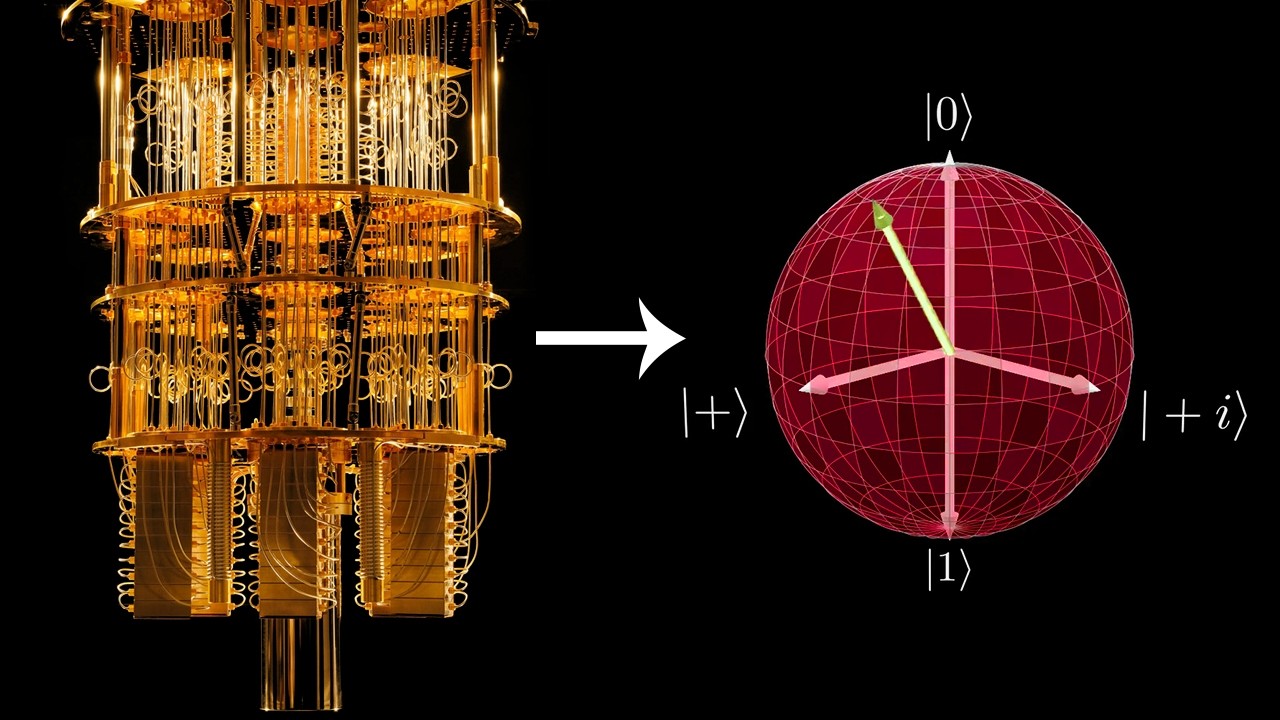
- 😀 Quantum mechanics is the basis for technologies like lasers, transistors, computer chips, and even emerging fields such as quantum computing, which promises vastly superior processing power.
Q & A
What is Quantum Mechanics and why is it important?
-Quantum Mechanics is the branch of physics that deals with the behavior of tiny particles, such as atoms and photons. It is crucial because it governs the fundamental building blocks of nature, influencing everything from smartphone batteries to the sun's light, and even the functioning of our own bodies.
What was the main breakthrough by Max Planck in Quantum Mechanics?
-Max Planck's major contribution was the idea that energy is quantized. He proposed that energy is not a continuous flow but instead comes in small packets, which he called 'quanta.' This idea helped resolve issues in classical physics and laid the foundation for quantum mechanics.
How did Planck's theory address the problem of Black Body Radiation?
-Planck's theory explained that black bodies emit energy in discrete packets (quanta), not continuously. This resolved the 'ultraviolet catastrophe' by showing that the energy emitted by a black body, especially in ultraviolet light, is limited and not infinite as earlier theories suggested.
What is the significance of Planck's constant?
-Planck's constant is a fundamental quantity in quantum mechanics that relates the energy of a photon to its frequency. It is a key constant that governs how quantum systems behave and is essential for calculations involving energy quantization.
How did Albert Einstein extend Planck's work in Quantum Mechanics?
-Einstein built on Planck's work by explaining the photoelectric effect. He showed that light behaves both as a wave and as a particle (photon). When light hits a metal surface, it can eject electrons, which was not explained by classical wave theory but was clarified through quantum mechanics.
What is the Photoelectric Effect, and why was it a mystery before Einstein's explanation?
-The photoelectric effect occurs when light strikes a metal surface, causing the emission of electrons. Classical wave theory couldn't explain why increasing light intensity did not increase the number of emitted electrons, but Einstein clarified that light consists of quanta (photons), and only photons with sufficient energy could release electrons.
What is Bohr’s model of the atom and its contribution to Quantum Mechanics?
-Niels Bohr's model of the atom introduced the concept that electrons exist in specific energy levels around the nucleus. They can only jump between these levels by absorbing or emitting a specific amount of energy, a quantum leap. This model explained the stability of atoms and their emission spectra.
What is the Uncertainty Principle in Quantum Mechanics?
-The Uncertainty Principle, introduced by Werner Heisenberg, states that it is impossible to simultaneously know the exact position and momentum of a particle. The more precisely one is measured, the less precisely the other can be known. This principle highlights the inherent limitations in our ability to measure quantum systems.
What is Quantum Superposition, and how does it differ from classical physics?
-Quantum Superposition is the principle that a quantum system can exist in multiple states at the same time until it is measured. This is different from classical physics, where an object can only be in one state at a time. A common example is the double-slit experiment, where particles behave as both waves and particles.
What is Quantum Entanglement, and why was it puzzling to Einstein?
-Quantum Entanglement describes a phenomenon where two particles, no matter how far apart, remain connected. A change in one particle instantaneously affects the other. Einstein called it 'spooky action at a distance' because it seemed to defy the conventional laws of physics, but it has been experimentally verified.
How is Quantum Mechanics applied in technology today?
-Quantum mechanics has revolutionized technology by enabling the development of lasers, transistors, and computer chips, which are integral to modern electronics. It is also paving the way for advancements in quantum computers, which could solve complex problems much faster than classical computers.
What is the potential of Quantum Technology in the future?
-Quantum technology promises breakthroughs in many fields. Quantum computers could solve problems that are currently unsolvable, quantum communication networks could provide ultra-secure communication, and quantum sensors could revolutionize fields like medicine and energy, offering faster and more precise measurements.
Outlines

هذا القسم متوفر فقط للمشتركين. يرجى الترقية للوصول إلى هذه الميزة.
قم بالترقية الآنMindmap

هذا القسم متوفر فقط للمشتركين. يرجى الترقية للوصول إلى هذه الميزة.
قم بالترقية الآنKeywords

هذا القسم متوفر فقط للمشتركين. يرجى الترقية للوصول إلى هذه الميزة.
قم بالترقية الآنHighlights

هذا القسم متوفر فقط للمشتركين. يرجى الترقية للوصول إلى هذه الميزة.
قم بالترقية الآنTranscripts

هذا القسم متوفر فقط للمشتركين. يرجى الترقية للوصول إلى هذه الميزة.
قم بالترقية الآن


5.0 / 5 (0 votes)

