Lecture 64 FTTH Passive Optical Networks
Summary
TLDRThis lecture delves into Passive Optical Networks (PON), a critical technology for Fiber to the Home (FTTH) networks. PONs are low-cost, scalable, and secure, using optical splitters instead of electronic switches to serve many users with minimal infrastructure. The lecture covers different PON types, such as GPON, EPON, and RFoG, with an emphasis on GPON's widespread adoption. It also explores the evolution of 10-Gig GPON, offering faster speeds and longer distances. The discussion touches on system architecture, applications, and practical design challenges, including the use of remote OLTs for rural networks. Further resources on PON and FTTH are available through the Fiber Optic Association (FOA).
Takeaways
- 😀 Passive Optical Networks (PONs) are the primary method used for building Fiber to the Home (FTTH) networks.
- 😀 PONs are called 'passive' because they rely on optical splitters instead of active electronic switches, reducing complexity and cost.
- 😀 One of the main advantages of PONs is their low cost, with savings in both capital expenditure (CAPEX) and operational expenditure (OPEX).
- 😀 PONs are inherently secure because the splitter sends the same signal to all subscribers, but privacy is maintained by encrypting the signals.
- 😀 PONs can handle voice, data, and video (triple play services) and are scalable from a small number of users to large city-wide networks.
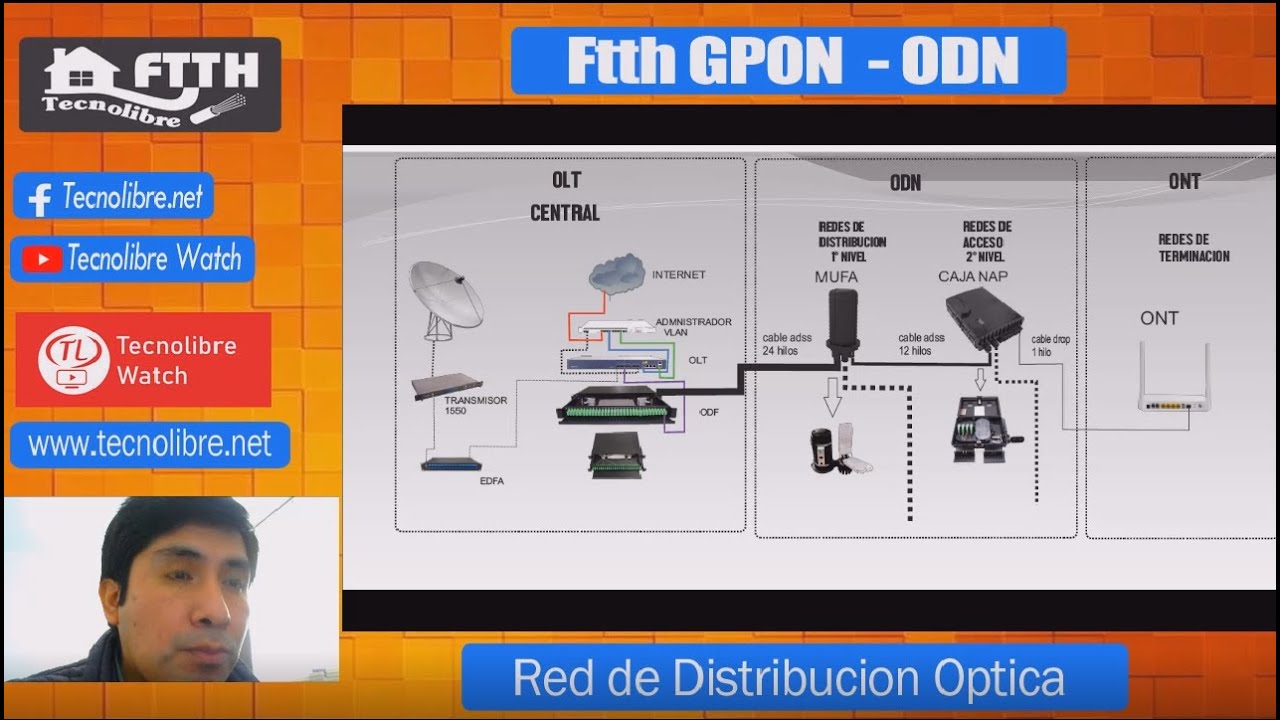
- 😀 Optical Line Terminals (OLTs) at the headend connect to Optical Network Terminals (ONTs) at the subscriber's end, facilitating bi-directional communication over a single fiber.
- 😀 The most commonly used PON protocol today is GPON (Gigabit Passive Optical Network), which is based on Ethernet-like protocols and supports distances up to 60 kilometers.
- 😀 The next generation, 10G GPON, provides faster speeds (10 Gbps), longer distances (up to 60 km), and supports more splits, allowing for more users on the network.
- 😀 Splitters in PONs allow for efficient distribution of signals, with configurations ranging from 1x2 to 1x32, and can be cascaded to further optimize network design.
- 😀 Rural networks can benefit from remote OLTs, which use one or two ports and connect to smaller, localized splitter boxes, ideal for small towns or farm clusters.
- 😀 The FOA offers numerous resources, including YouTube videos and online courses, to learn more about fiber optics, FTTH architectures, and PON technologies.
Q & A
What is a Passive Optical Network (PON) and why is it called 'passive'?
-A Passive Optical Network (PON) is a fiber optic network that delivers data from a central office to multiple subscribers using optical splitters. It is called 'passive' because it contains no active electronic components between the central office (OLT) and the subscriber (ONT); the signal is split and transmitted without electronic amplification.
What are the main advantages of PONs compared to traditional all-electronic networks?
-PONs have lower capital and operational costs, require no intermediate electronics or power, are scalable for small to very large user bases, easy to manage, support triple play services (voice, data, video), and provide inherent security when combined with encryption.
What are the key components of a PON network?
-The key components include the Optical Line Terminal (OLT) at the central office or headend, optical splitters typically located in a Fiber Distribution Hub (FDH), the distribution network connecting splitters, and the Optical Network Terminal (ONT) at the subscriber end.
How does a PON achieve bidirectional communication on a single fiber?
-PONs use different wavelengths for downstream (1490 nm) and upstream (1310 nm) signals, allowing both directions of communication to share a single fiber while splitters distribute and combine signals efficiently.
What is the difference between GPON, BPON, and EPON?
-BPON was the first widely used broadband PON, largely obsolete now. GPON (Gigabit PON) is Ethernet-based and most popular, supporting high speeds and scalable splits. EPON (Ethernet PON) is IEEE-standard, also Ethernet-based, but less widely adopted.
What are the features of 10G-PON networks?
-10G-PON networks offer 10 Gbps speeds, support distances up to 60 km, can split to 32, 64, 128, or 256 users, and use different wavelengths than 1G-PON, enabling simultaneous operation over the same cable plant.
How are optical splitters used in PONs, and how is their loss calculated?
-Optical splitters passively divide incoming signals into multiple outputs. Loss is typically calculated as 3 dB per 2× split plus excess loss from inefficiencies (around 1–4 dB), with cascading splitters being an efficient way to achieve higher splits.
What adaptations are used in PON networks for rural areas?
-For rural networks, remote OLTs with fewer ports are used, often mounted on utility poles. Taps with unequal splits (e.g., 90/10) may be used, though remote OLTs are generally more efficient, connecting a few subscribers over longer distances.
What are RFoG networks and how do they relate to PONs?
-RF over Glass (RFoG) networks are a version of cable TV's hybrid fiber-coaxial system implemented over a PON architecture. They allow cable TV providers to deliver services over the same fiber network used for GPON or EPON.
What resources does the FOA provide for learning more about FTTH and PONs?
-The FOA offers YouTube lectures on FTTH architectures, design, installation, and testing, an Online Reference Guide with detailed technical information, and Fiber U, a free online learning platform with self-study programs on fiber optics.
Why is network security a consideration in PONs, and how is it handled?
-Since optical splitters broadcast the same signal to all subscribers, privacy can be a concern. Security is handled by encrypting the signal for each user, ensuring that each subscriber receives only their intended data.
Outlines

هذا القسم متوفر فقط للمشتركين. يرجى الترقية للوصول إلى هذه الميزة.
قم بالترقية الآنMindmap

هذا القسم متوفر فقط للمشتركين. يرجى الترقية للوصول إلى هذه الميزة.
قم بالترقية الآنKeywords

هذا القسم متوفر فقط للمشتركين. يرجى الترقية للوصول إلى هذه الميزة.
قم بالترقية الآنHighlights

هذا القسم متوفر فقط للمشتركين. يرجى الترقية للوصول إلى هذه الميزة.
قم بالترقية الآنTranscripts

هذا القسم متوفر فقط للمشتركين. يرجى الترقية للوصول إلى هذه الميزة.
قم بالترقية الآنتصفح المزيد من مقاطع الفيديو ذات الصلة



5.0 / 5 (0 votes)

