Permutations and Combinations - Formulae | Don't Memorise | GMAT/CAT/Bank PO/SSC CGL
Summary
TLDRThis video provides a clear and detailed explanation of permutations and combinations, focusing on understanding the logic behind them before using formulas. It highlights the key difference: permutations involve arrangements where order matters, while combinations involve selections where order does not matter. Through practical examples, such as forming teams with specific roles or selecting items without regard to order, viewers learn when to apply each concept. The video also introduces the standard formulas for calculating permutations (nPr = n!/(n-r)!) and combinations (nCr = n!/(r!(n-r)!)), emphasizing the importance of distinct objects and no repetition, making the concepts easier to grasp and apply in problem-solving.
Takeaways
- 😀 Permutations involve arranging objects where the order matters, while combinations involve selecting objects where the order does not matter.
- 😀 Permutations are denoted as nPr, representing the arrangement of 'r' objects out of 'n'.
- 😀 Combinations are denoted as nCr, representing the selection of 'r' objects out of 'n'.
- 😀 ABC and ACB are considered different in permutations, but the same in combinations.
- 😀 Selecting a team with specific roles (like VP, manager, product developer) is a permutation problem because order matters.
- 😀 Selecting a team without assigning roles is a combination problem because order does not matter.
- 😀 If additional distinctions are given, like ice cream flavors for each person, it can turn a selection problem into a permutation problem.
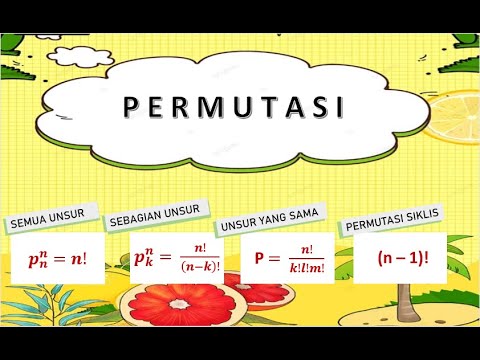
- 😀 The formula for permutations is nPr = n! / (n - r)! and helps quickly calculate arrangements without repetition.
- 😀 The formula for combinations is nCr = n! / (r! * (n - r)!) and helps quickly calculate selections without caring about order.
- 😀 Understanding the logic behind when to use permutations vs combinations is essential before applying formulas.
- 😀 Practicing problems using these formulas becomes faster and easier once the conceptual difference is clear.
- 😀 Repetition of objects is not allowed in standard permutation and combination problems unless explicitly stated.
Q & A
What is the main difference between permutation and combination?
-Permutation is about arranging things where the order matters, while combination is about selecting things where the order does not matter.
How is permutation denoted and what does the notation mean?
-Permutation is denoted as nPr, which represents arranging r things out of n distinct objects.
How is combination denoted and what does the notation mean?
-Combination is denoted as nCr, which represents selecting r things out of n distinct objects without regard to order.
Can you give an example where permutation is used?
-If we select a team of 3 people out of 10 and assign specific roles such as Vice President, Manager, and Product Developer, the order matters, so this is a permutation problem.
Can you give an example where combination is used?
-If we select a leadership team of 3 out of 10 people without specifying roles, the order does not matter, so this is a combination problem.
Why does the order matter in permutation but not in combination?
-In permutation, each unique arrangement counts as a different outcome, whereas in combination, only the group of selected items matters, not the order in which they are selected.
What is the formula for permutation and how is it applied?
-The permutation formula is nPr = n! / (n-r)!. For example, arranging 3 people out of 10: 10P3 = 10! / 7! = 10 × 9 × 8 = 720 ways.
What is the formula for combination and how is it applied?
-The combination formula is nCr = n! / [r!(n-r)!]. For example, selecting 2 people out of 5: 5C2 = 5! / (2! × 3!) = 10 ways.
How does repetition of objects affect permutation problems?
-In standard permutation problems discussed here, objects must be distinct and repetition is not allowed. Cases like 111 or 232 are invalid.
How can the concept of permutation and combination be applied to everyday examples?
-Permutation can be applied when assigning roles, seating arrangements, or any scenario where order matters. Combination applies when forming groups, choosing lottery numbers, or selecting items where order does not matter.
Outlines

هذا القسم متوفر فقط للمشتركين. يرجى الترقية للوصول إلى هذه الميزة.
قم بالترقية الآنMindmap

هذا القسم متوفر فقط للمشتركين. يرجى الترقية للوصول إلى هذه الميزة.
قم بالترقية الآنKeywords

هذا القسم متوفر فقط للمشتركين. يرجى الترقية للوصول إلى هذه الميزة.
قم بالترقية الآنHighlights

هذا القسم متوفر فقط للمشتركين. يرجى الترقية للوصول إلى هذه الميزة.
قم بالترقية الآنTranscripts

هذا القسم متوفر فقط للمشتركين. يرجى الترقية للوصول إلى هذه الميزة.
قم بالترقية الآنتصفح المزيد من مقاطع الفيديو ذات الصلة

Combinaciones, permutaciones y variaciones | Ejemplo 2
KOMBINASI | Matematika Wajib Kelas XII
PERMUTASI - Jenis Permutasi - Matematika SMA/SMK

Ohhh, jadi begini cara bedain KOMBINASI sama PERMUTASI | Pembahasan materi KOMBINASI PERMUTASI

Aprenda Análise Combinatória sem Decorar Fórmulas em 21 min
Math 119, 4.4 Lecture Video
5.0 / 5 (0 votes)

