Administração Científica || Taylorismo || Princípios, Características, Ensinamentos, ORT, Criticas
Summary
TLDRThis video explores the transformative impact of the Industrial Revolution on society and the emergence of scientific management, particularly through the work of Frederick Winslow Taylor. It highlights Taylor's contributions to industrial efficiency and labor practices, emphasizing his focus on productivity, worker incentives, and process optimization. The video also discusses the influence of Taylor's principles on Henry Ford, who revolutionized production with assembly lines. While acknowledging criticisms of Taylorism, such as mechanization and worker alienation, the video underscores Taylor's pivotal role in shaping modern management practices and continuing development in the field.
Takeaways
- 🏭 The Industrial Revolution brought significant societal changes, including mass migration from rural areas to cities, leading to chaotic urban growth and serious social problems.
- 👷♂️ Industrial organizations grew rapidly, employing many workers with long hours, low wages, and poor working conditions, resulting in high employee turnover.
- 📊 Early management scholars sought to improve organizational efficiency, giving rise to the Scientific Management movement.
- 📚 Frederick Winslow Taylor, known as the father of Scientific Management, emphasized applying scientific methods to improve work processes and productivity.
- ⚙️ Taylor's principles included scientific task design, selection and training of workers, and close cooperation between management and employees to optimize efficiency.
- ⏱️ Key techniques included time and motion studies, studying human fatigue, task specialization, job design, and functional supervision.
- 💰 Incentives and the concept of 'homo economicus' were central, assuming workers are primarily motivated by monetary rewards.
- 🚗 Henry Ford applied Taylorist principles in his assembly line, achieving massive production efficiency gains, drastically reducing production time per vehicle.
- -
- 📉 Taylorism and Fordism faced criticism for mechanizing work, neglecting workers’ psychosocial needs, causing physical exhaustion, and limiting creativity and interpersonal interaction.
- 🌟 Despite criticisms, Taylor’s work laid the foundation for modern management studies and organizational transformation, influencing subsequent management theories.
Q & A
What major social changes did the Industrial Revolution bring according to the script?
-The Industrial Revolution caused mass migration from rural areas to cities, resulting in chaotic urban growth, poor living conditions, and long working hours with low wages, which created serious social problems.
Who is considered the father of scientific management and why?
-Frederick Winslow Taylor is considered the father of scientific management because he applied scientific methods to improve work processes, increase efficiency, and align workers' tasks with their abilities.
What is 'systematic soldiering' as described by Taylor?
-'Systematic soldiering' refers to workers producing less than their potential output. Taylor argued that this was due to poor management, not the workers, and that proper task design and incentives could increase productivity.
What are the key principles of Taylor's scientific management?
-The key principles include: scientific task analysis, study of fatigue, division of labor, designing jobs and tasks, financial incentives, the concept of 'homo economicus', improving working conditions, standardization of tools and processes, and functional supervision.
How did Henry Ford implement Taylor’s principles in his factories?
-Henry Ford applied Taylor's principles through assembly line production, specialization of labor, production in mass, increased efficiency, and optimization of resources, reducing car production time from 12 hours to about 84 minutes.
What are the three main principles of Fordism highlighted in the script?
-The three main principles are productivity (maximize output and reduce costs), intensification (accelerate capital turnover), and economicity (minimize raw material in process to reduce waste and labor storage).
What were the main criticisms of Taylorism?
-Criticisms include the mechanization of work, neglect of psychological and social aspects of workers, excessive specialization, physical exhaustion, and suppression of initiative and interpersonal relationships.
Why did Taylor emphasize cooperation between management and workers?
-Taylor emphasized cooperation to create a favorable psychological environment, ensuring tasks were executed efficiently and productivity was maximized while aligning incentives for mutual benefit.
What role does standardization play in scientific management?
-Standardization ensures consistency in tools, methods, and equipment, reduces variations, minimizes waste, and streamlines processes to improve productivity and efficiency.
How did scientific management influence later administrative studies?
-Scientific management laid the foundation for modern administrative theory, influencing subsequent management approaches by emphasizing efficiency, systematic analysis of work, and the structured organization of labor and processes.
What is the concept of 'homo economicus' and how does it relate to Taylorism?
-'Homo economicus' is the idea that workers are primarily motivated by financial incentives. In Taylorism, this concept supports the use of wages and material rewards to increase productivity.
How did studying human fatigue contribute to Taylor's management methods?
-Studying human fatigue helped identify optimal work methods and rest periods, rationalize movements, reduce errors and accidents, and decrease worker turnover, thereby improving overall productivity.
Outlines

هذا القسم متوفر فقط للمشتركين. يرجى الترقية للوصول إلى هذه الميزة.
قم بالترقية الآنMindmap

هذا القسم متوفر فقط للمشتركين. يرجى الترقية للوصول إلى هذه الميزة.
قم بالترقية الآنKeywords

هذا القسم متوفر فقط للمشتركين. يرجى الترقية للوصول إلى هذه الميزة.
قم بالترقية الآنHighlights

هذا القسم متوفر فقط للمشتركين. يرجى الترقية للوصول إلى هذه الميزة.
قم بالترقية الآنTranscripts

هذا القسم متوفر فقط للمشتركين. يرجى الترقية للوصول إلى هذه الميزة.
قم بالترقية الآنتصفح المزيد من مقاطع الفيديو ذات الصلة

Taylorism ABC World Report
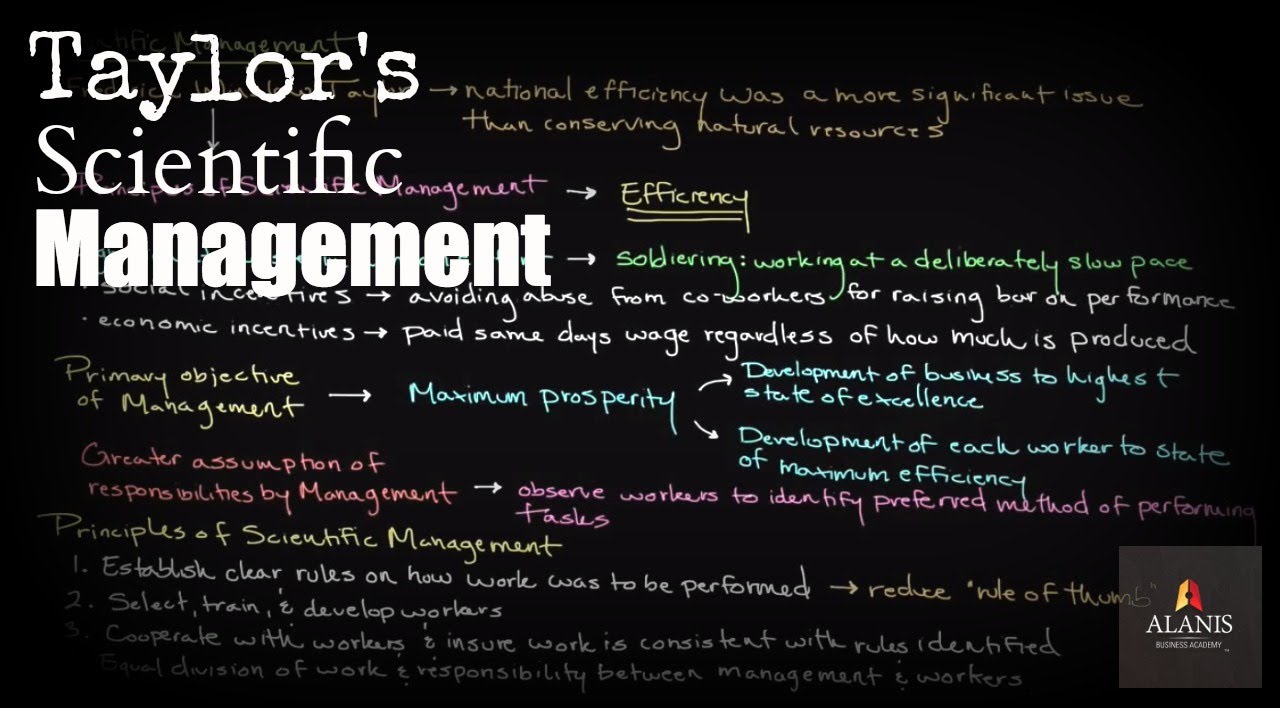
Frederick Winslow Taylor's Scientific Management
Principles of Scientific Management | Meaning and Techniques

Frank and Lillian Gilbreth

Estudos Organizacionais - Abordagem Científica da Administração - Introdução às Teorias... (LIBRAS)

Taylorismo║Conceito, Contexto Histórico, Características, Objetivos, Princípios║RESUMO animado
5.0 / 5 (0 votes)

