IDIOLOGI
Summary
TLDRThis video provides a comprehensive overview of ideology, exploring its etymology, definitions by various scholars, key elements, and characteristics. It distinguishes between open and closed ideologies, illustrating their influence through symbols, myths, and knowledge. The discussion emphasizes Pancasila as Indonesia's national ideology, highlighting its foundational, instrumental, and practical values, adaptability, and role in shaping national identity, social harmony, and governance. Additionally, it compares global ideologies such as liberalism, communism, and fascism, analyzing their core principles, legal frameworks, economic roles, religious views, and perspectives on individuals and society, providing viewers with a clear understanding of ideological diversity and application.
Takeaways
- 🧠 Ideology comes from the Greek words 'idea' (ideas or ideals) and 'logos' (knowledge), meaning a system of ideas or goals formed through thought and knowledge.
- 📚 In general, ideology refers to fundamental values and beliefs upheld as guidelines for life and society.
- 👨🏫 Various scholars define ideology as a structured set of ideas, values, and beliefs that shape institutions and human behavior.
- 🏗️ Three essential elements of ideology are: a system of ideas or values, supporters who believe in it, and actions to realize those ideals.
- 👥 In a country, citizens serve as supporters who implement ideological values to achieve national goals.
- 🔓 Open ideologies allow interpretation, criticism, adaptation, and selective acceptance of external influences; examples include Pancasila and liberalism.
- 🔒 Closed ideologies are dogmatic, discourage criticism, reject external influence, and tightly control followers; communism is presented as an example.
- 💬 Ideology can be expressed through symbols, myths, and scientific reasoning to strengthen acceptance among supporters.
- 🌍 Ideology helps shape a nation's identity and distinguishes it from other countries through unique values and principles.
- 🤝 Ideology functions as a tool for resolving social conflicts and guiding society toward unity and common goals.
- 🇮🇩 Pancasila as Indonesia’s national ideology contains three levels of values: basic values, instrumental values, and practical values.
- ⚖️ Pancasila is considered an open ideology because its core principles remain fixed while practical applications adapt to changing times.
- 🌐 Pancasila encourages Indonesia to face globalization while maintaining national identity and preserving the unity of the country.
- 🕊️ Liberalism emphasizes individual freedom, democracy, market economics, and limited restrictions on personal rights.
- 🚩 Communism prioritizes state and party interests over individual interests, with centralized authority and strict government control.
- 🏛️ Fascism emphasizes total state authority, strict discipline, and strong government control over society and economic activities.
- 📊 Pancasila, liberalism, and communism differ in law, economics, religion, and perspectives on individuals and society.
- 🙏 Under Pancasila, religion plays an important role in social life, while liberalism treats religion as a private matter and communism is portrayed as rejecting religion.
- 💰 In economics, Pancasila promotes state involvement to prevent monopolies, liberalism favors free markets, and communism supports state dominance.
- ⚡ Pancasila seeks balance between individual rights and societal interests, unlike liberalism's focus on individuals and communism's focus on collectivism.
Q & A
What is the meaning of ideology according to its etymological origin?
-Ideology comes from the Greek words 'idea' and 'logos'. 'Idea' means ideals or concepts, while 'logos' means knowledge or science. Therefore, ideology refers to ideas or ideals that result from human thought and knowledge.
How is ideology defined in general terms?
-Ideology is generally defined as a set of basic values or ideas that are upheld and used as guidance in life and society.
What are the three essential elements of an ideology?
-The three essential elements are: a systematic set of ideas or values, a group of supporters who believe in the ideology, and the implementation of those ideas to achieve shared goals or ideals.
What is the difference between an open ideology and a closed ideology?
-An open ideology allows interpretation, criticism, and adaptation to changing times, while a closed ideology rejects criticism and outside influence, often becoming dogmatic.
Why is Pancasila considered an open ideology?
-Pancasila is considered an open ideology because it can adapt to social and global developments while still maintaining Indonesia’s national identity and core values.
What is an example of a closed ideology mentioned in the script?
-Communism, especially as practiced in North Korea, is mentioned as an example of a closed ideology because criticism and external influences are not accepted.
What are the three ways ideology can be expressed according to the script?
-Ideology can be expressed through symbols, myths, and scientific or intellectual foundations.
What role does ideology play in a country?
-Ideology helps form national identity, provides solutions to social conflicts, gives direction to society, and influences the behavior of citizens according to shared values.
What are the three values contained in Pancasila as a national ideology?
-The three values are fundamental values, instrumental values, and practical values.
What are fundamental values in Pancasila?
-Fundamental values are the universal ideals and goals contained in Pancasila and reflected in the preamble of the 1945 Constitution.
How does the script describe liberal ideology?
-Liberal ideology emphasizes individual freedom, democracy, free-market economics, transparency in government, and minimal restrictions on personal rights.
What are the main characteristics of communist ideology according to the script?
-Communist ideology prioritizes the state and party over individuals, tends to be atheistic, uses authoritarian government systems, and controls many aspects of life.
What is fascism as explained in the script?
-Fascism is an ideology where the state has absolute authority over citizens, and people are expected to follow strict discipline for national goals under strong government control.
How does Pancasila differ from liberalism in terms of religion?
-Pancasila recognizes religion as an important part of national life and allows citizens to choose among recognized religions, while liberalism treats religion mainly as a private matter.
How does communism view religion according to the script?
-Communism is described as viewing religion as a harmful influence or 'poison,' and it generally does not recognize belief in God.
What is the role of the state in the economy under Pancasila ideology?
-Under Pancasila, the state has a role in preventing monopolies and ensuring economic fairness while balancing private and public interests.
How does liberal ideology approach the economy?
-Liberal ideology supports limited government intervention, free competition, private ownership, and capitalism.
What is the economic characteristic of communist ideology?
-Communist ideology gives the state dominant control over the economy and prioritizes collective ownership over individual ownership.
How does Pancasila balance individual and societal interests?
-Pancasila recognizes both individual rights and the importance of society, emphasizing harmony and cooperation between individuals and the community.
Why is understanding ideology important according to the script?
-Understanding ideology is important because it shapes national identity, guides social behavior, influences government systems, and helps citizens respond to social and global challenges.
Outlines

This section is available to paid users only. Please upgrade to access this part.
Upgrade NowMindmap

This section is available to paid users only. Please upgrade to access this part.
Upgrade NowKeywords

This section is available to paid users only. Please upgrade to access this part.
Upgrade NowHighlights

This section is available to paid users only. Please upgrade to access this part.
Upgrade NowTranscripts

This section is available to paid users only. Please upgrade to access this part.
Upgrade Now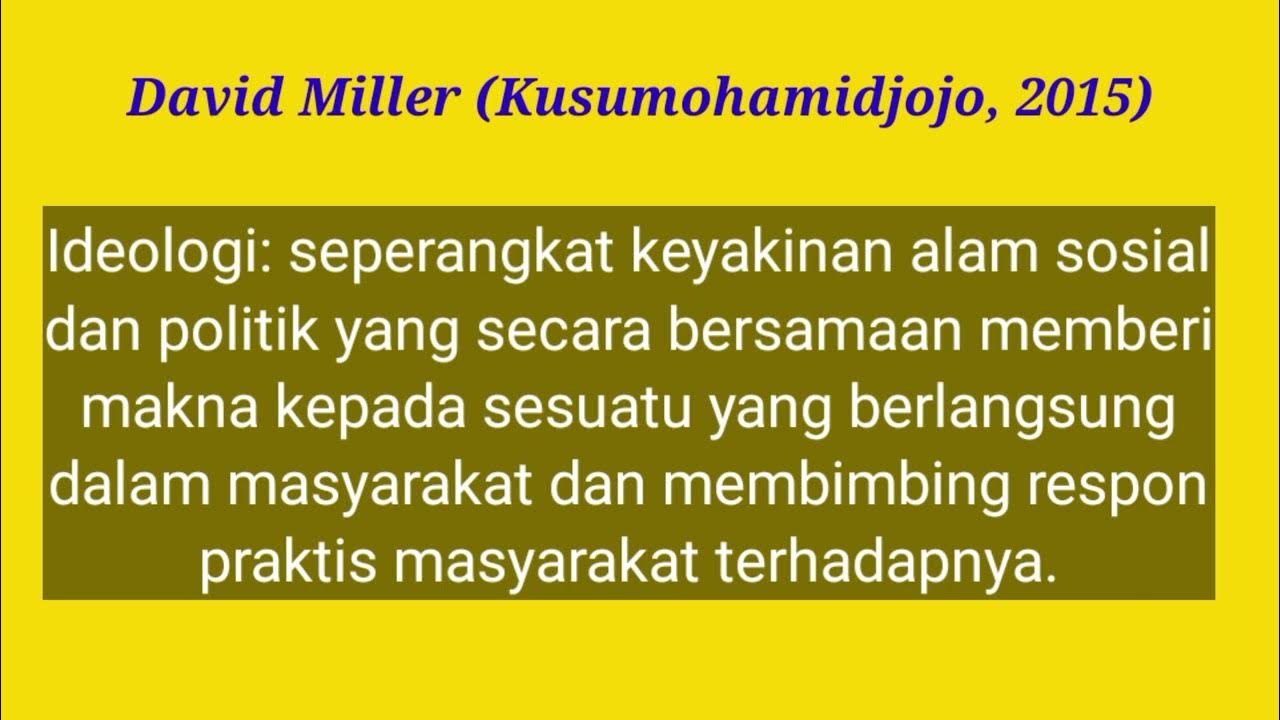




5.0 / 5 (0 votes)
