Unidade II - Fundamentos Antropológicos e Sociológicos – Cultura
Summary
TLDRThis lesson provides an introduction to culture in the context of sociology and anthropology. It explores the definition of culture, emphasizing that all human societies possess culture, which is not superior or inferior but different. Key concepts like ethnocentrism, cultural relativism, and acculturation are discussed, with examples drawn from films like *The Gods Must Be Crazy* and *Chocolate*. The video delves into the dynamics of cultural diversity, particularly in Brazil, and the impact of globalization on cultural exchange. It also highlights how culture evolves and how values, norms, and social structures shape human identity and behavior.
Takeaways
- 😀 Culture is a broad concept that encompasses beliefs, knowledge, values, customs, and symbols shared within a society.
- 😀 All humans possess culture, and no culture is superior to another—cultures simply differ from one another.
- 😀 Ethnocentrism is the belief that one's own culture is superior to others, often leading to prejudice and cultural imposition.
- 😀 The film 'The Gods Must Be Crazy' demonstrates how different cultures assign distinct meanings to objects and symbols.
- 😀 Human culture is distinguished from animals by the ability to accumulate knowledge and adapt behaviors through learning and socialization.
- 😀 Culture is transmitted through socialization, rather than biology, and plays a key role in shaping social identity and behavior.
- 😀 The Latin word 'cultura' refers to cultivating or caring for something, highlighting the relationship between culture and the development of knowledge.
- 😀 Anthropologists like Edward Taylor and Franz Boas have contributed key definitions of culture, which encompass arts, beliefs, laws, and social customs.
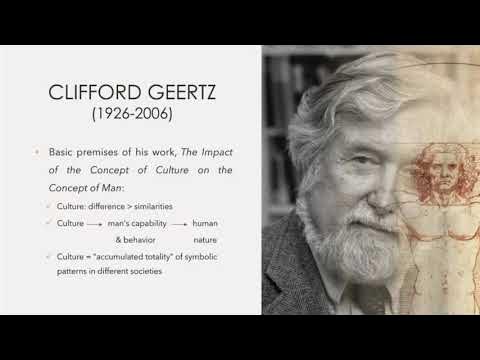
- 😀 Clifford Geertz's perspective on culture sees it as a system of symbols and meanings that guides human behavior and social interaction.
- 😀 Cultural diversity refers to the variety of cultural expressions, ideas, and elements across different societies, shaped by migration, colonization, and globalization.
- 😀 Cultural relativism encourages understanding and valuing other cultures within their own context, avoiding judgment based on one's own cultural norms.
Q & A
What is the general definition of culture in the context of this lecture?
-Culture is a term with many meanings. In common usage, it refers to accumulated knowledge, but from an anthropological and scientific perspective, culture is seen as a shared system of beliefs, values, customs, and symbols passed through generations within a group of people.
What does the film 'The Gods Must Be Crazy' illustrate about cultural differences?
-The film portrays how cultural meanings can differ between groups. It shows a tribe's reaction to an object, a Coca-Cola bottle, that falls from an airplane. The tribe believes the bottle is a gift from the gods, which leads to chaos until the tribe decides to return the bottle, highlighting how different cultures interpret objects and behaviors uniquely.
Why is culture considered unique to humans, according to the lecture?
-Culture is exclusive to humans because it involves learned knowledge, values, traditions, and behaviors that are passed down from one generation to another. Unlike animals, whose behavior is driven by instincts, humans modify behavior through cultural practices.
How is the term 'culture' related to the Latin word 'coler'?
-The word 'culture' comes from the Latin word 'coler,' which means to cultivate or care for. This reflects the idea of 'cultivating knowledge' and signifies the process of nurturing and passing down cultural practices.
What does 'ethnocentrism' refer to in the context of this lecture?
-Ethnocentrism is when one culture views its own customs, values, and traditions as superior to others and attempts to impose these beliefs on different groups. It leads to a prejudiced view of other cultures, considering them as inferior or 'primitive.'
How does cultural relativism contrast with ethnocentrism?
-Cultural relativism encourages understanding other cultures from their own context and values, avoiding judgments based on one's own cultural standards. Unlike ethnocentrism, which creates a hierarchy of cultures, relativism sees cultural differences as valuable and deserving of respect.
What is the importance of studying culture from an anthropological perspective?
-Studying culture from an anthropological perspective helps us understand the common ways of life within different societies, how values and behaviors are transmitted, and how they shape identity. It also aids in understanding cultural diversity and avoiding prejudiced views.
What is acculturation, and can you provide an example from Brazilian culture?
-Acculturation is the process by which a culture absorbs or adopts aspects of another culture through social interaction. An example from Brazilian culture is the blending of African, Indigenous, and European cultural influences, which has shaped the country's diverse traditions and practices.
Why is the concept of cultural diversity important in modern societies?
-Cultural diversity highlights the variety of ideas, practices, and characteristics across different groups. Understanding and respecting cultural diversity fosters tolerance, reduces prejudice, and helps societies navigate the complexities of globalization and intercultural interactions.
How does globalization affect local cultures?
-Globalization promotes interaction between different cultures, which can lead to the adoption of global cultural norms and practices. However, it also sparks a renewed focus on preserving regional traditions and identities, creating a balance between global influence and local cultural pride.
Outlines

This section is available to paid users only. Please upgrade to access this part.
Upgrade NowMindmap

This section is available to paid users only. Please upgrade to access this part.
Upgrade NowKeywords

This section is available to paid users only. Please upgrade to access this part.
Upgrade NowHighlights

This section is available to paid users only. Please upgrade to access this part.
Upgrade NowTranscripts

This section is available to paid users only. Please upgrade to access this part.
Upgrade NowBrowse More Related Video





5.0 / 5 (0 votes)
