Integral Fungsi Aljabar • Part 3: Contoh Soal Integral Tak Tentu Fungsi Aljabar Sederhana (1)
Summary
TLDRIn this video, the channel 'Jendela Sains' explores indefinite integrals of simple algebraic functions. The host provides step-by-step examples, covering constant functions, powers of x, negative exponents, roots, and multi-term expressions. Each integral is carefully solved using standard formulas, demonstrating how to handle coefficients, combine exponents, and convert between fractional and root forms. Viewers are guided through practical tips for transforming complex expressions into integrable forms, with clear explanations for each step. By the end, learners gain a comprehensive understanding of basic integration techniques, making it easier to approach similar algebraic integral problems confidently.
Takeaways
- 😀 The video explains how to calculate indefinite integrals of simple algebraic functions.
- 😀 Constant functions integrate as the constant multiplied by x plus C, e.g., ∫3 dx = 3x + C.
- 😀 The power rule for integration is used: ∫x^n dx = x^(n+1)/(n+1) + C for n ≠ -1.
- 😀 Coefficients in front of functions can be left outside the integral during calculation.
- 😀 Negative exponents are handled by increasing the exponent by one and dividing, e.g., ∫x^-2 dx = -1/x + C.
- 😀 Multiplying powers of x is simplified by adding the exponents before integrating, e.g., x^2√x becomes x^(5/2).
- 😀 Fractional exponents from roots can be converted into standard powers for easier integration.
- 😀 Complex polynomials can be separated into individual terms, integrated separately, and then summed.
- 😀 Integration of sums or differences of functions follows the property: ∫(f±g) dx = ∫f dx ± ∫g dx.
- 😀 The constant of integration 'C' is added once at the end for the entire integral, not for each term separately.
- 😀 Understanding how to manipulate powers and coefficients is key to solving various algebraic integrals efficiently.
- 😀 The video emphasizes step-by-step transformation of expressions to simplify integration for each example.
Q & A
What is the formula used to integrate a constant function?
-The formula for integrating a constant function, like ∫a dx, is ax + C, where 'a' is the constant, and 'C' is the integration constant.
How do you integrate a function like ∫-x dx?
-To integrate ∫-x dx, you apply the power rule. Since x is x^1, you increase the exponent by 1 and divide by the new exponent, resulting in -x^2/2 + C.
What is the result of ∫6x² dx?
-For ∫6x² dx, the constant 6 stays outside the integral, and applying the power rule gives 2x³ + C.
How do you handle integrals of rational functions like ∫5/x² dx?
-For integrals of rational functions like ∫5/x² dx, rewrite x² as x^(-2) and then use the power rule. The result is -5/x + C.
How do you integrate functions involving powers and roots, like ∫2x²√x dx?
-To integrate functions like ∫2x²√x dx, first express √x as x^(1/2), then combine exponents. This simplifies to ∫2x^(5/2) dx, and the integral is 4x^(7/2)/7 + C.
What happens when you integrate a function with a fractional exponent in the denominator, like ∫5/√[3]{x} dx?
-To integrate ∫5/√[3]{x} dx, convert the fractional exponent in the denominator to a negative exponent, and then apply the power rule. The result is (15x^(2/3))/2 + C.
How do you solve an integral that involves multiple terms like ∫(6x² - 2x + 3 - 2x³) dx?
-For an integral like ∫(6x² - 2x + 3 - 2x³) dx, break it down into separate integrals for each term. Applying the power rule for each term, the final result is 2x³ - x² + 3x - (2x⁴/4) + C.
Why is the constant of integration 'C' added in indefinite integrals?
-The constant of integration 'C' is added in indefinite integrals because the integration process is the reverse of differentiation, and a constant can disappear during differentiation, so it must be included to account for all possible solutions.
What does the power rule for integration state?
-The power rule for integration states that ∫x^n dx = (x^(n+1))/(n+1), where n is any real number except -1.
What is the correct way to handle an integral with a term like x^(-2) or x^(-3)?
-For integrals of the form x^(-2) or x^(-3), you apply the power rule as usual. For example, ∫x^(-2) dx = -x^(-1) + C, and ∫x^(-3) dx = -x^(-2)/2 + C.
Outlines

このセクションは有料ユーザー限定です。 アクセスするには、アップグレードをお願いします。
今すぐアップグレードMindmap

このセクションは有料ユーザー限定です。 アクセスするには、アップグレードをお願いします。
今すぐアップグレードKeywords

このセクションは有料ユーザー限定です。 アクセスするには、アップグレードをお願いします。
今すぐアップグレードHighlights

このセクションは有料ユーザー限定です。 アクセスするには、アップグレードをお願いします。
今すぐアップグレードTranscripts

このセクションは有料ユーザー限定です。 アクセスするには、アップグレードをお願いします。
今すぐアップグレード関連動画をさらに表示

Integral Fungsi Aljabar • Part 2: Integral Fungsi Operasi dan Integral Tak Tentu

Aplikasi Integral • Part 6: Surplus Konsumen dan Surplus Produsen
MATEMATIKA Kelas 11 - Integral Tak Tentu | GIA Academy
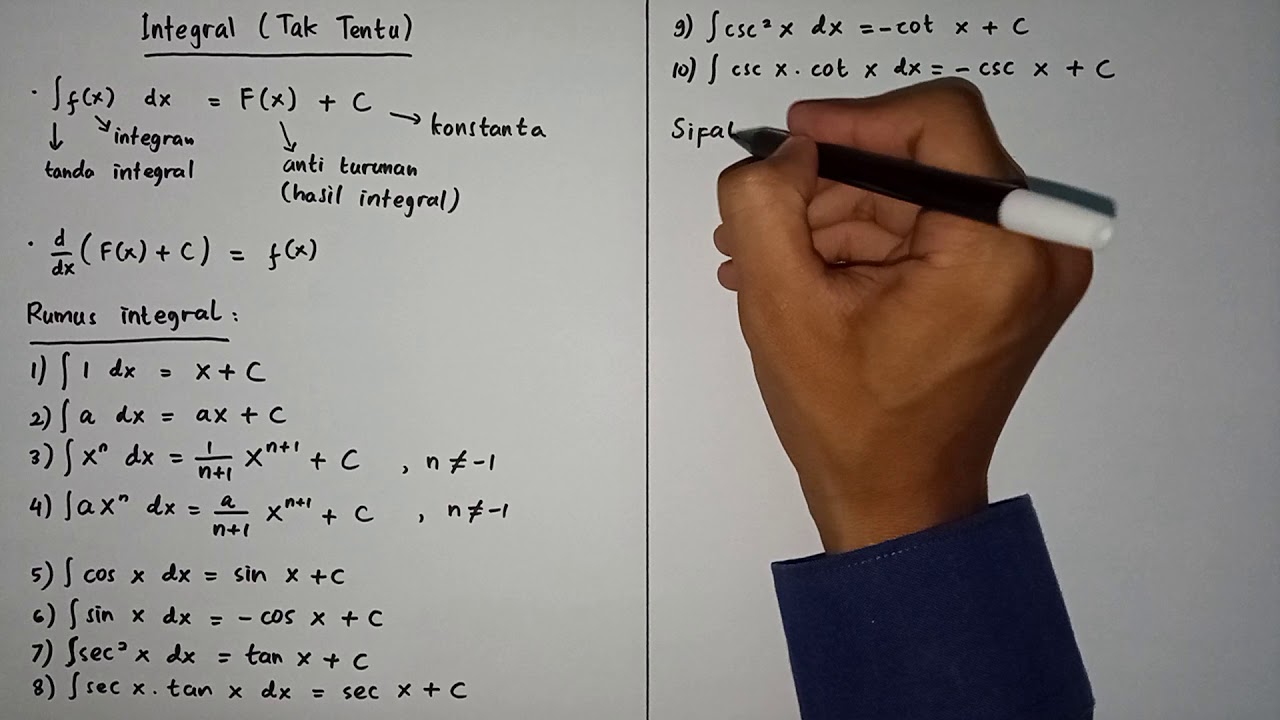
Integral (Tak Tentu)
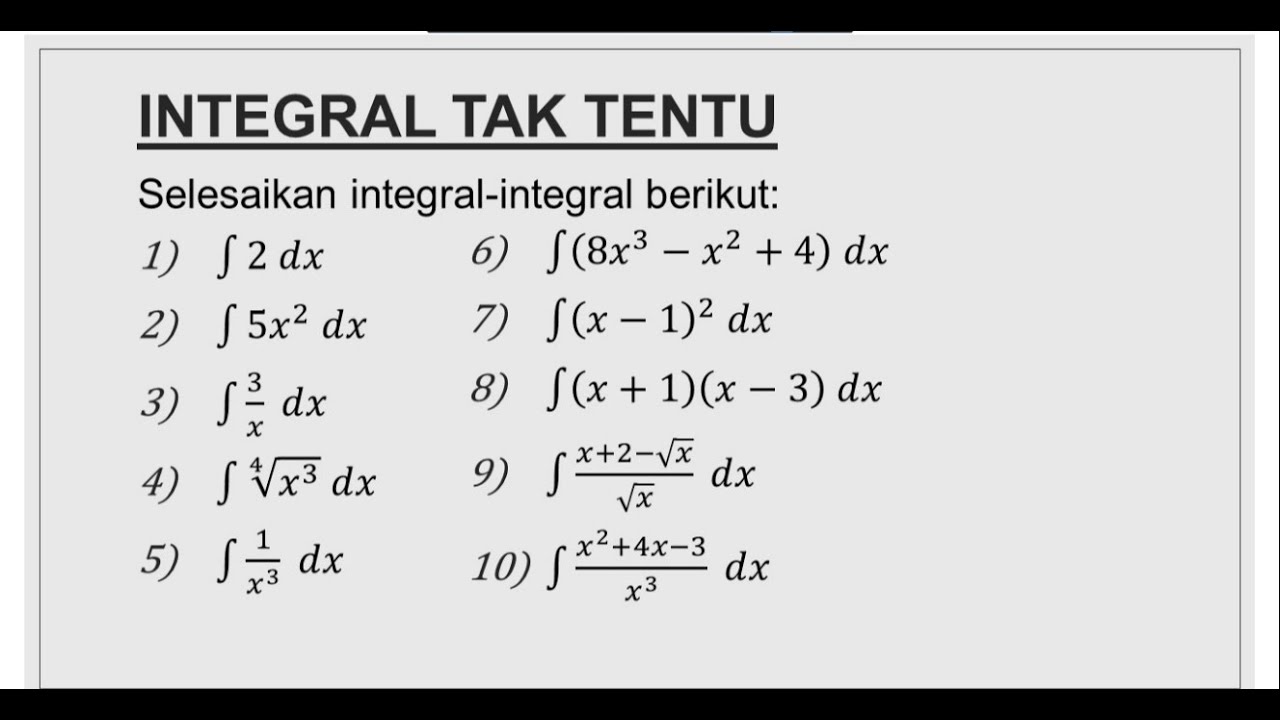
INTEGRAL TAK TENTU
Integral Fungsi Aljabar Matematika Kelas 11 • Part 1: Pengertian Integral & Integral Tak Tentu
5.0 / 5 (0 votes)

